
How to Search for a Warrant in Arizona
Arizona offers several public routes, and each answers a different question. The Arizona Department of Public Safety (AZDPS) runs a name-and-date-of-birth warrant search drawing on information reported by various courts. The Arizona Judicial Branch Public Access portal is a different animal entirely. It is a case index, not a warrant register, and neither source lists every participating court or every local warrant. The court that issued an order keeps the case record. A sheriff or other peace officer may serve the paper, but only the issuing court can confirm whether a warrant remains open. Before you search, gather the person's full legal name, date of birth, and any case or citation paper already on hand. Begin with the official tools, then take any result to the court that handled the case. The sequence here covers the statewide channels plus the local checks that turn a hit into a confirmed answer.
- Search the AZDPS Warrant Search with first name, last name, and date of birth. Treat a result as a lead because AZDPS says its data is not real time, current, active, or complete.
- Use Arizona Public Access as a second case-search lead. Its query screen is CAPTCHA gated, and a case entry does not establish that a warrant is active.
- Identify the court tier and contact its clerk. The Arizona Courts Locator helps find the right court; the County Directory routes to county court and sheriff resources.
- Ask the issuing court about current status, bond, and the next required step. Contact the county sheriff or warrant unit for service, surrender, or jail-release logistics, since local disclosure practices vary.
- For a releasable agency record, use the relevant public-record request process under Arizona Public Records Law. For a traffic registration hold, check TTEAP separately; for a federal docket, use PACER/CM/ECF or contact the U.S. Marshals Service.
One Arizona county sheriff's office posts its public-record request route and links to the agency request form.
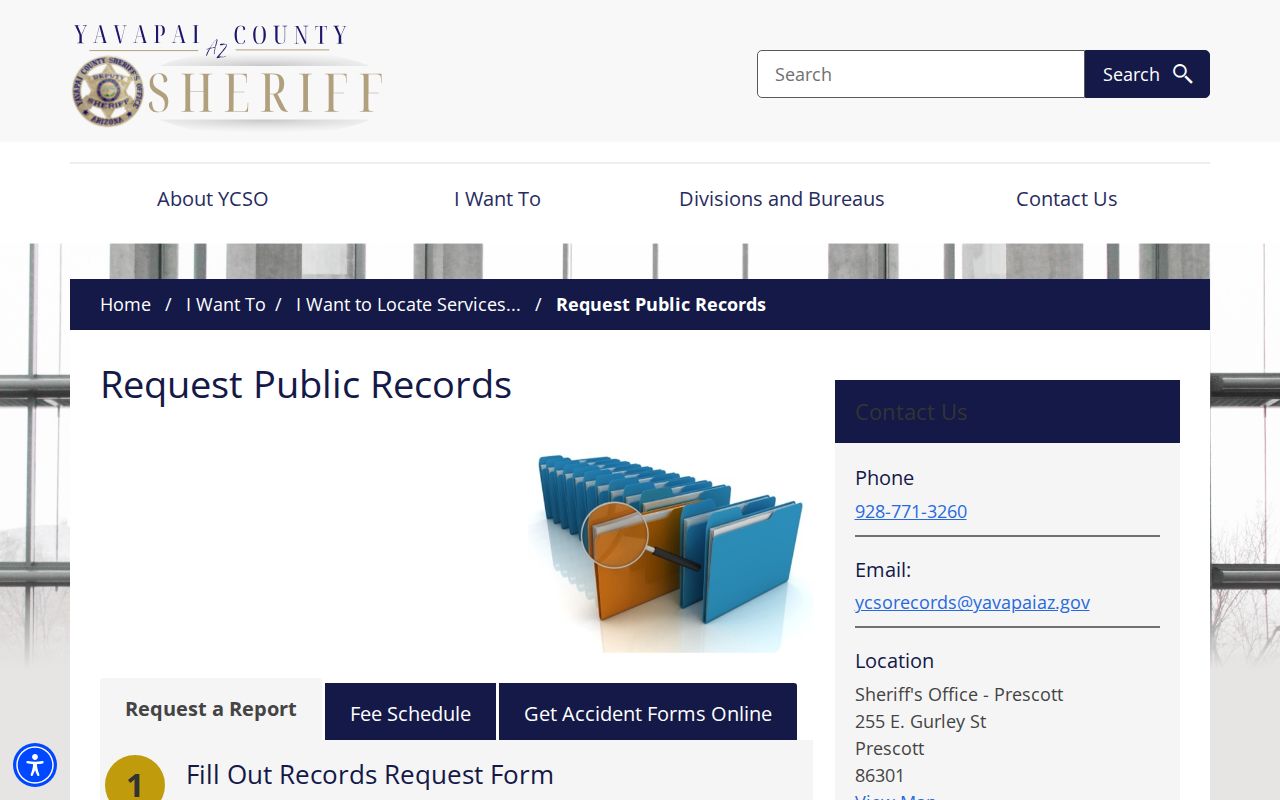
That county example is an agency-record request process. It is not a statewide Arizona warrant lookup, and it does not confirm current warrant status.
Note: A written records request may locate an existing record, but it is not a live warrant-status service and cannot open sealed court material.
Arizona Warrant Search Starts at AZDPS
The public AZDPS form is Arizona's statewide warrant-specific search. It queries information reported by various courts, but AZDPS publishes no roster of which courts participate, no date range, and no list of excluded warrant classes. Treat the result as a starting point, not a certification that every court has reported or that every warrant type appears. The agency also states plainly that the search is not updated in real time and that it does not represent results as current, active, or complete. When a result comes back, AZDPS directs the searcher to contact the court listed with it. That direction matters. Court staff can pull the case record and explain whether a hearing, motion, or other action is needed. A sheriff's online lookup may add local service information, but county tools differ across Arizona. Read the statewide portal no further than its own instructions allow. The Arizona Department of Public Safety warrant page shows the public search form and the name and birth-date fields it requires.
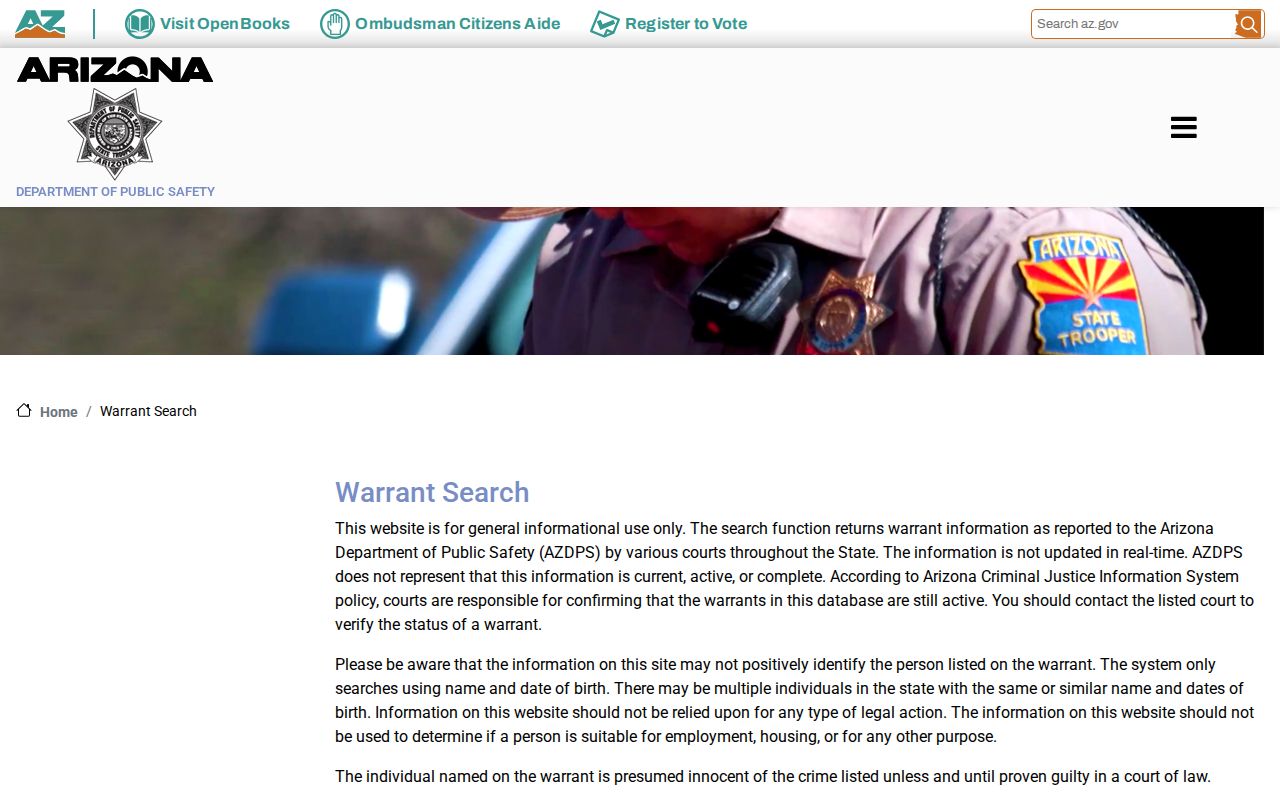
The blank form shows the limited identifiers available for a public Arizona search. It displays no result and certifies nothing about a warrant's status.
Arizona Warrant Search Fields
Every AZDPS query asks for the same three identifying details. The accessible form has no county, court, warrant-type, or status filter, and it documents no partial-name or wildcard matching. Use the exact details you have. Then compare any possible match with the issuing court's information rather than guessing from a similar name.
| Field Label | Type | Required | Notes |
|---|---|---|---|
| First Name | Text input | Yes | No partial-name or wildcard behavior is documented. |
| Last Name | Text input | Yes | Enter the person's name as accurately as possible. |
| Date of Birth | Date-like input | Yes | The public page does not state an exact format. |
| Apply | Button | n/a | Submits the search; no other filter or sort control is documented. |
The form allows up to five results. There is no documented control for raising that limit. The query fields narrow a name search, but the public page does not explain how Arizona collisions are resolved or which courts contributed a record.
Arizona Public Access Is a Case Index
Public Access and AZDPS serve separate purposes. Public Access is a Judicial Branch case index for participating courts, not a statewide warrant search. Its notice says the portal covers 177 of 184 courts, updates each Friday with data through Wednesday, and may omit cases even at a participating court. Local ordinance cases and several sensitive categories are excluded. The live search form also sits behind a verification step, so older training materials may not describe what you actually see.
| Source | What It Searches | Known Limit |
|---|---|---|
| AZDPS Warrant Search | Reported warrant leads queried by name and date of birth. | Coverage and result schema are not fully published; status is not certified. |
| Arizona Public Access | Case-index information from participating courts. | Weekly data, incomplete case coverage, exclusions, and CAPTCHA-gated search. |
| Issuing court | The official docket and court-side warrant status. | Remote access to some records is restricted; contact the court for instructions. |
A case index can tell you where a matter was filed. It cannot turn a missing case into proof that no warrant exists, and it does not reproduce every document in the file. When it points to a likely court, ask that Arizona court what can be released and how to verify the warrant.
Note: Public Access's 177-of-184 court coverage describes that case portal only; it does not describe AZDPS warrant-search participation.
Arizona's Judicial Branch Public Access portal opens with participation and update notices before any case search begins.
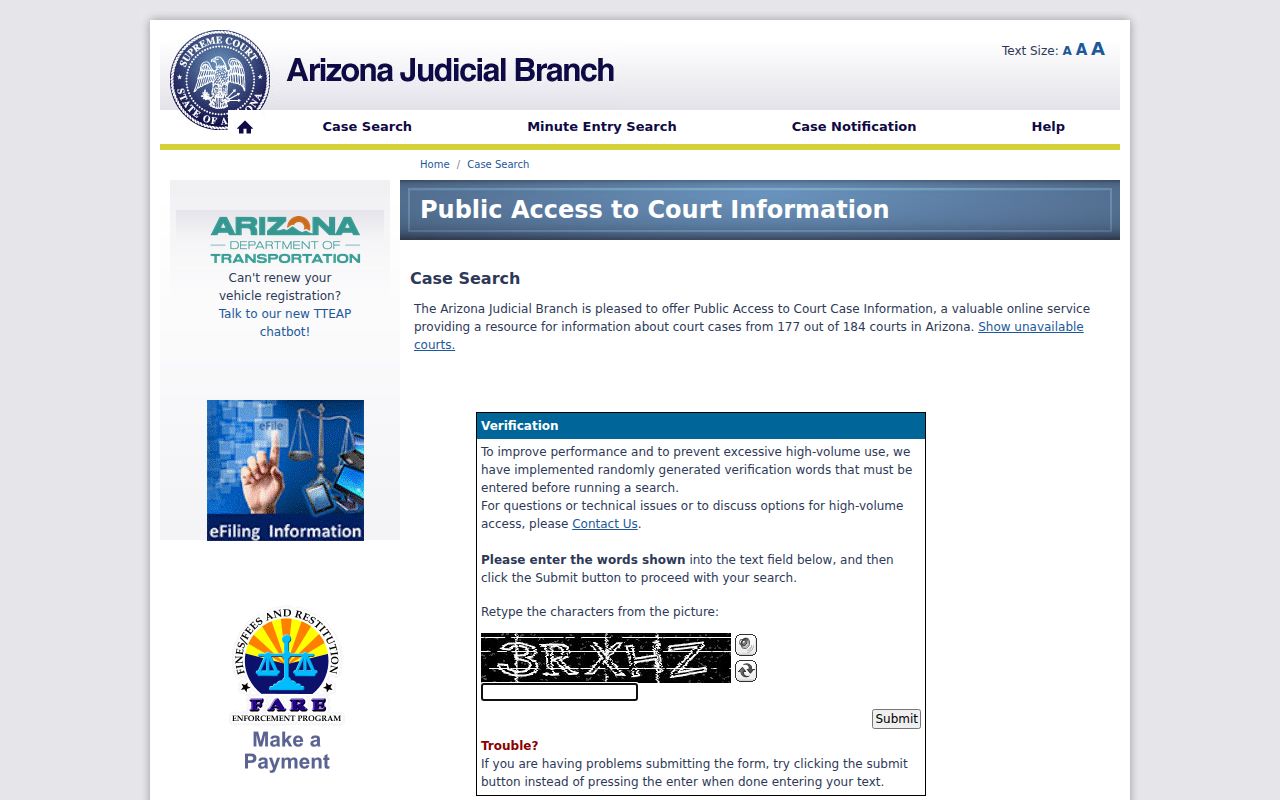
That gate is a reminder: Public Access remains a separate case index with its own coverage limits across Arizona.
What a Warrant Search Shows
Arizona's public warrant search publishes no full list of result fields. The page does not document what a hit displays, so do not assume a charge, issuing judge, bond amount, holding agency, warrant date, or current status appears. AZDPS does document a five-result cap. It also warns that one unique warrant number may show up with variations in a subject's displayed name. That duplicate display does not mean there are multiple warrants.
| Search basis | Required first name, last name, and date of birth. |
|---|---|
| Result limit | Up to five results; no public control to change the limit is documented. |
| Warrant number | AZDPS says one unique warrant number may repeat with name variations; no number format is published. |
| Record fields | The public page does not specify a complete result schema. Do not infer bond, charge, judge, or status fields. |
| Current status | Confirm with the court identified in a result; the search disclaims currentness and completeness. |
A match in an Arizona warrant search is only a starting point. Check the name, birth date, and case context against the papers you already hold. Do the details line up? If the birth date or case context does not fit, call the listed court and ask the clerk to check the official file. A public name match prompts verification; it decides nothing about identity.
Note: AZDPS says a repeated unique warrant number can reflect name variations, so duplicate display lines do not prove separate warrants.
Arizona Warrant Search Results Need Confirmation
A possible match from AZDPS should send you to the court named in the result. That is your next stop. Ask the clerk pointed questions. Is the warrant still active? Is a bond set, and what appearance does the judge require? Will the court consider recall or a new date? The clerk can walk you through filing and scheduling steps, but Arizona clerks cannot give legal advice, and no clerk can cancel a warrant without a judicial order. A lawyer can help you weigh the safest way to appear or ask the court for relief in Arizona. What about a blank result? The confirmation path still matters. Reporting can lag, a court may not feed the portal, a case may be restricted, or the matter may sit in a lower Arizona court. The AZDPS notice itself warns that a search may not be current or complete. Keep the two risks straight: an online Arizona result can be stale or mistaken, and no result is not proof that no warrant exists. Federal cases run on a separate track. A public docket search may show case activity, yet it does not certify that an arrest warrant is active. Sealed or unserved warrant records may not surface in a name search. For any question about federal process, contact the appropriate federal court or the U.S. Marshals office rather than treating an Arizona state portal as a federal registry.
Where to Check Warrants in Arizona
Arizona runs three trial-court tiers, and each keeps its own records. Superior Court handles felony matters, with files held by the county Clerk of the Superior Court. Justice Courts take many precinct-level traffic and misdemeanor cases. Municipal Courts handle city and town ordinance matters plus many traffic or state-law misdemeanor cases, and each lower court keeps its own docket. So a Superior Court search or a sheriff's list may not show a city-court matter at all. Your citation, hearing notice, or case number points to the right court. If those papers are missing, Arizona's court-finding tools can flag likely courts by location and case type. Then use the County Directory to reach county-level court, clerk, and sheriff resources in one place. A county sheriff can answer questions about service or custody. But the court that issued the order controls its status and recall. Ready to find the right venue? The Arizona Courts Locator lists the official routes to Superior, Justice, and Municipal Courts across the state.
Use the Arizona Courts Locator to pick the likely venue, then ask that court directly. Ask it to confirm the case and the current warrant status. Some county sheriff websites publish their own warrant search; others point users back to the court, limit phone disclosures, or route records requests through a public-records portal. Arizona has no single statewide sheriff lookup form with uniform fields. Treat a county site as one more local channel. It never replaces the issuing court's file for warrant status in Arizona.
Arizona Lower-Court Warrants Can Be Missed
Miss a traffic date in a city or precinct court, and a local bench warrant can follow. That record may never reach a statewide case index. Ordinance cases and courts left out of a search are common reasons. A county sheriff's online tool has its own limits too. These gaps do not mean the lower Arizona court lacks a case or that no warrant was issued. For a traffic ticket, first identify the issuing body. Was it a Municipal Court or a Justice Court? Contact that clerk. A state-law traffic citation can land in either tier, depending on where and how the case was filed. Start with the court printed on the notice. If that is unclear, ask the clerk or consult the Arizona Court Locator. The local docket, not a general search result, settles the court-side question about an Arizona warrant.
Note: A search channel's coverage says what that channel can display, not whether another Arizona court has an open warrant record.
Restricted Warrants and Access Rules
Arizona public-record access has real limits. The Arizona Public Records Law, through A.R.S. §39-121 and §39-121.01, generally allows inspection of public agency records subject to lawful restrictions. Court files answer to judicial access rules as well. Under Arizona Supreme Court Rule 123, certain warrant documents and pre-charge arrest-warrant requests have limits on remote public access. A docket event may show up even when the document itself cannot be opened. Juvenile records face additional limits under A.R.S. §8-208. Sealed proceedings, protected personal data, and active investigative material can also narrow what a public search displays in Arizona. If a record is missing, ask the court whether it is restricted and what access procedure applies. A public-record request can seek an existing releasable agency record. It cannot force disclosure of a sealed court document or verify live warrant status.
Key point: Public access has legal limits, and a missing online entry does not prove that no Arizona warrant exists. Contact the issuing court to confirm status and available next steps.
Arizona TTEAP Holds Are Not Warrants
Arizona runs a separate program called the Traffic Ticket Enforcement Assistance Program, or TTEAP. It is not a warrant search. The program flags a vehicle-registration renewal hold tied to a qualifying traffic obligation, which matters when a renewal gets blocked at the Motor Vehicle Division. Arizona's TTEAP lookup asks for a person's full name and date of birth. A registration hold is an administrative consequence. It is not a warrant, a driver's-license suspension, or a general search of court warrants. A traffic warrant and a TTEAP hold can sit side by side, and fixing one does not fix the other. Paying the traffic obligation may clear the registration hold through the court's collection process, but only the issuing court can recall or quash a warrant. So check two channels. Look at the court record for any active warrant. Use the TTEAP lookup for the hold. The Arizona Courts TTEAP page links to the program and its public lookup, and each office that controls a record can confirm what it shows.
Note: A TTEAP match concerns registration renewal, while warrant status remains with the court that issued the order.