
Arizona Active Warrants Explained
An active or outstanding warrant is simply an order the issuing court has not marked as served, recalled, or closed. Arizona publishes no single list that certifies every open warrant. The AZDPS Warrant Search shows information that various courts report, while county sheriff tools and court dockets cover different local records, so each channel can be incomplete or delayed. The court that issued the warrant keeps the case file and decides its current status, the bond, and the next step.
A search result can point you toward the right court, but it is not a final status check. A missing entry may reflect a reporting gap, a recent court action, a lower-court case, or a restricted record. A name match may also need identity confirmation before anyone treats it as yours. For more official search channels, see the Warrant Lookup. Use those sources to check your own matter or help a family member, then ask the Arizona court directly what its record shows.
The Judicial Branch self-check article sends people to the court that issued the warrant and to the court locator when the record holder is unclear. That keeps confirmation with the issuing court rather than with an online result. Read Arizona court guidance on checking for a pending warrant.
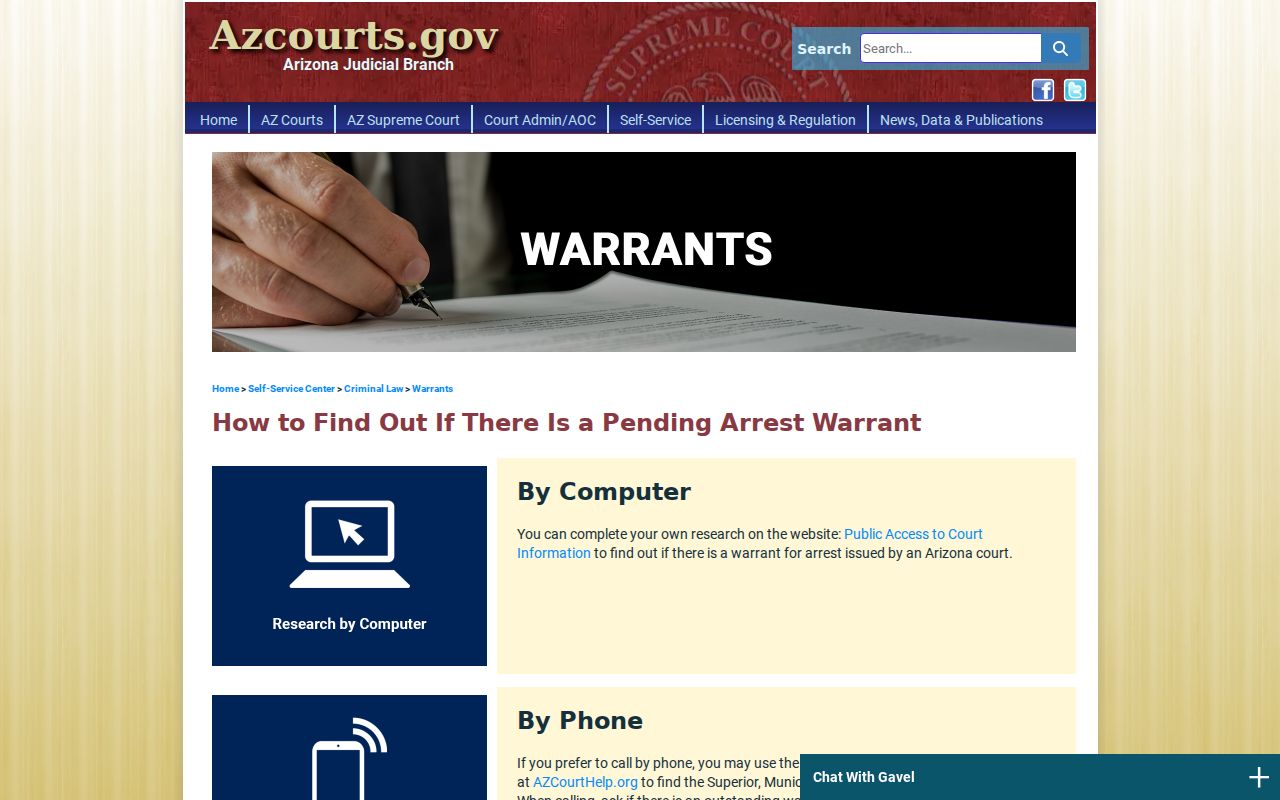
The Arizona guidance points every confirmation back to the issuing court. An online result, on its own, is never a status decision.
Arizona Active Warrant Search Is Not Certified
AZDPS runs the state's public warrant-specific search, yet its own notice says the information comes from various courts and is not updated in real time. The agency does not represent results as current, active, or complete. It publishes no roster of reporting courts, no covered date range, and no list of the warrant classes included. The Arizona page asks for a first name, last name, and date of birth, allows up to five results, and offers no public county, court, warrant-type, or status filters.
Treat the search as a lead, then, not an official active-warrant certificate. AZDPS directs anyone with a result to contact the listed court, and that court can verify whether the order remains open and explain the appearance, bond, or recall process. A hit may be stale or belong to someone with a similar name. No result may simply mean the information was never reported to Arizona or cannot be shown publicly.
How Arizona Tracks Active Warrants
Arizona's public systems share no common update schedule. AZDPS describes court-reported warrant information but never says how often its search refreshes. County sheriff sites set their own tools and disclosure rules: some run a search, some direct a caller to the court, and some keep service or extradition details inside the agency. No published statewide count of active warrants exists to measure the full open caseload. Keep in mind that absence from a statewide index or a county list does not prove that no warrant exists.
Arizona Public Access is a separate court case index. It reports data from 177 of 184 courts and updates each Friday with information through Wednesday, while warning that participating courts may still have cases missing. That weekly rhythm belongs to the case index alone. It says nothing about how often AZDPS or the county warrant pages refresh, because the actual warrant record stays with the issuing court and the local agency handling service.
Note: No search cadence or complete participation list is published for AZDPS, so even a recent-looking search cannot establish statewide completeness.
Arizona Active Warrants and Public Access
Public Access can help you locate a case, but it is not a warrant register. Its search screen sits behind a CAPTCHA, and not every case at a participating court appears. The portal excludes local ordinance cases and limits remote access to several sensitive categories. A docket entry may point you toward the right court without showing the warrant document or confirming the order remains active. Arizona keeps its scope separate from AZDPS, whose warrant search draws on a different source and publishes no participation map.
| Channel | Purpose | Limit to Keep in Mind |
|---|---|---|
| AZDPS Warrant Search | Public search of court-reported warrant leads. | Not real time, current, or complete by its own disclaimer. |
| Arizona Public Access | Case-index search for participating courts. | Weekly refresh, incomplete cases, exclusions, and CAPTCHA-gated query. |
| Issuing court | Official case and warrant status. | Some documents have restricted remote access; ask the clerk about procedure. |
The coverage figures for Public Access say nothing about how many courts report warrants to AZDPS. A case-search result and a warrant-search result are two different leads. Neither Arizona tool replaces a direct status check with the court that issued the order.
Inside an Active Warrant Record
AZDPS documents no standard result schema. The public search page does not promise that a result will show a charge, bond, judge, issuing county, service agency, or current status. It does note that the same unique warrant number can appear with variations in the subject's name. So an Arizona listing may not carry every field, and unknown fields should not be assumed present in each result.
| Search identifiers | First name, last name, and date of birth are required. |
|---|---|
| Maximum results | The public query returns no more than five results. |
| Warrant number | One unique number may be repeated under name variations; its format is not documented. |
| Charge and bond | The public page does not promise these fields. Ask the issuing court. |
| Active status | AZDPS disclaims currentness and tells users to confirm with the court. |
Treat any Arizona entry as a pointer, not a file. The real record sits with the clerk. A case number or court name on the entry belongs in your call. If the listing is thin on detail, give the court the name, birth date, and any citation or case information you have so the clerk can find the right matter.
Arizona Warrant Searches Can Miss Lower Courts
Arizona warrant searches often miss the lower courts, and that gap matters. City ordinance cases stay with the Municipal Court that heard them, while Justice Courts handle many precinct-level traffic and misdemeanor cases of their own. Each of those courts keeps its own record. Miss a city-court date and the bench warrant that follows may never show up in a Superior Court search or a general case portal. Public Access leaves out local ordinance cases entirely, and neither it nor AZDPS claims complete warrant coverage across Arizona. So if a notice traces back to a city or Justice Court, call that court's clerk first even when a statewide search comes back blank. The Arizona Courts Locator helps you match a location and case type to the right court, and the County Directory connects you to county-level court and sheriff resources in Arizona. The sheriff can walk you through service or custody questions. Only the issuing court can verify whether its warrant is still open.
Note: A blank public search only describes that search's records; it does not rule out a warrant held by a Municipal or Justice Court.
The Yuma County Sheriff's Office warrant department page lays out the office's role in Arizona and states plainly that warrant status is not given by telephone. That page shows the policy itself.
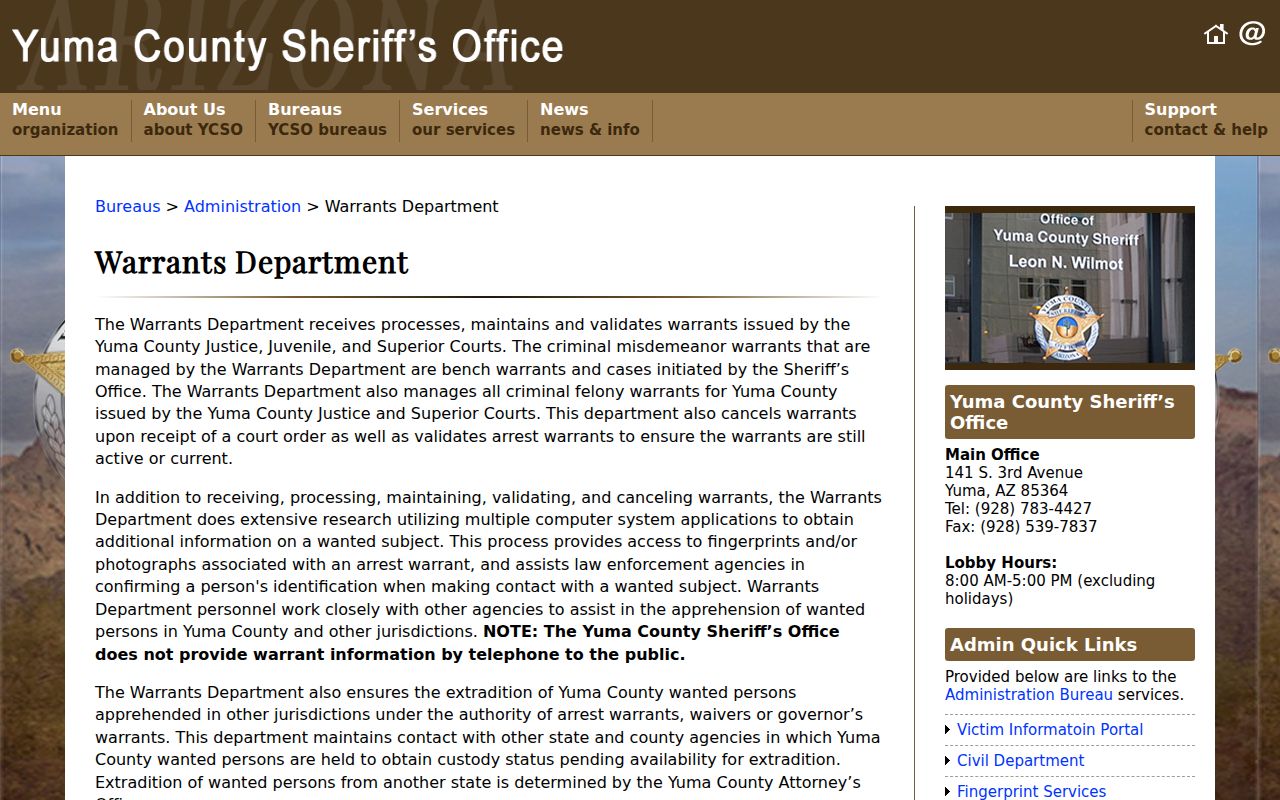
Arizona sets no statewide rule here. This is one county's policy, so lean on the issuing court and the county route for the case you are checking.
Warrant Roundups and Most-Wanted Lists
A most-wanted program and a full warrant search serve different jobs in Arizona. Arizona WANTED is a multiagency fugitive task force that works selected cases alongside U.S. Marshals and local or state partners. The Marshals Service District of Arizona also shares information on chosen fugitive cases. Neither program is a complete active-warrant list, and ordinary bench, traffic, or misdemeanor warrants rarely appear there. No statewide all-warrant roundup roster or reward schedule exists in Arizona. The Most Wanted List page has more detail on the official programs.
| Program | What It Does | What It Does Not Establish |
|---|---|---|
| Arizona WANTED Task Force | Coordinates selected fugitive investigations with partner agencies. | It is not a public search of all Arizona warrants. |
| U.S. Marshals District of Arizona | Provides a federal fugitive and task-force information route. | Its profiles are selected cases, not a complete state warrant index. |
Go to the government program page itself for current details. Arizona rosters shift and never list every warrant. That is why no names or photos belong on a general reference page, and why no program page doubles as a complete status system.
Key point: A curated fugitive profile is not proof that every other Arizona warrant is closed or that an unlisted person has no warrant.
Arizona WANTED Is a Fugitive Task Force
The Arizona WANTED Task Force concentrates on selected fugitives tied to violent crimes against people, weapons, felony drug crimes, sex-offender registration, or similar histories. That focus is about its enforcement mission, not the full span of warrants Arizona courts issue. A routine failure-to-appear warrant or a traffic matter can sit outside a fugitive program and still be a live court order. The U.S. Marshals District of Arizona posts a 24-hour fugitive tip line at 1-888-869-4589. A tip goes to law enforcement. It is never a request for you to approach or serve anyone, so do not contact a person shown on an official program page. If you are checking on your own Arizona warrant or helping a relative, treat AZDPS as a first lead and then ask the court or a lawyer about status and resolution.
When Your Name Is on the Warrant List
Seeing your name on an Arizona warrant list is not the moment to guess. A web listing does not hand you the current court order or the right next step. Confirm the issuing court first. Ask whether the warrant is still active, and ask how that court handles an appearance, bond, recall, or a request for a new date. A lawyer can help you weigh a motion, arrange a court appearance, or surrender under the court's own process. For the case record and the local service route in Arizona, open the County Directory. Recall or quash belongs to the issuing court alone, while the sheriff or serving agency can explain custody and release logistics. Paying the underlying case does not itself prove a judge recalled the warrant. Ask the clerk to confirm that a court order was entered, and keep a copy of the result.
Important: An active warrant can lead to arrest when officers encounter you. Confirm status with the court and consult an attorney before choosing how to appear.
Note: Ask the court how it records a recall, and keep the order or receipt after the case is addressed.
Arizona Warrant Records May Be Restricted
Arizona court access rules can keep warrant details out of remote searches. Under Arizona Supreme Court Rule 123, warrants and certain pre-charge arrest-warrant requests have restricted remote access until stated release conditions are met. Juvenile records face their own limits under A.R.S. §8-208. A case event can be visible even when the warrant document behind it is not. The Arizona Public Records Law opens many government records, subject to limits, but a records request is not a live verification service. When an Arizona search returns nothing, the record may be sealed, delayed, held by a lower court, or outside that portal's coverage. Ask the issuing court what can be released and how to confirm status. A blank result is never proof that no warrant exists. One county sheriff FAQ shows a local route: warrant questions get sent to the court of jurisdiction. That FAQ spells out the office's guidance.
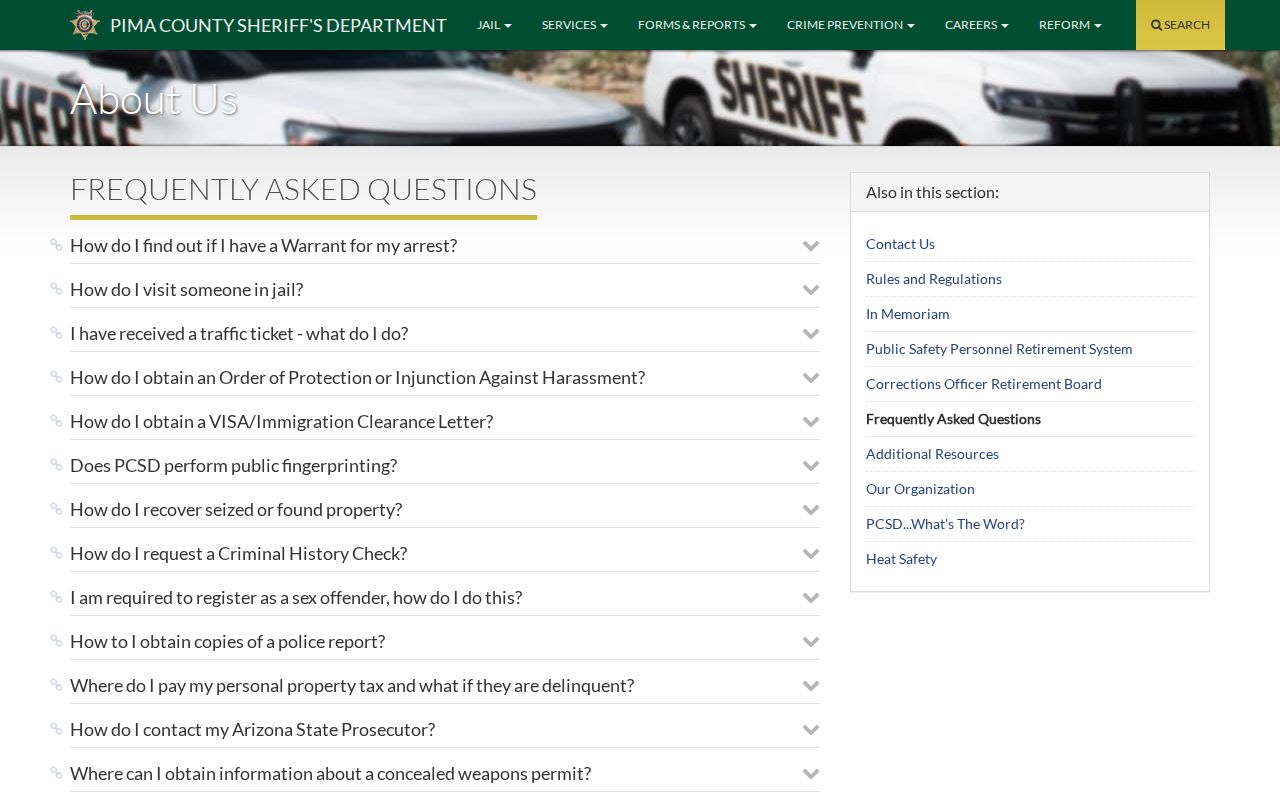
Arizona practice varies county by county. Treat that FAQ as one office's approach, and check the issuing court and sheriff route for your case.
Arizona TTEAP Holds Are Not Warrants
Arizona runs a program called TTEAP, short for Traffic Ticket Enforcement Assistance Program. It has nothing to do with warrants. The program places a hold on vehicle-registration renewal when a qualifying traffic debt sits unpaid. Its public lookup asks for a full name and date of birth, and a driver's-license number helps match the right account. What comes back describes a registration hold only. It says nothing about a driver's-license suspension, and it is not a warrant search. A traffic warrant and a TTEAP hold can certainly sit on the same case, yet clearing one tells you nothing about the other. Paying through the court's channel lifts the hold, but only a judge's order recalls a warrant. For warrant status, confirm with the issuing Municipal or Justice Court in Arizona. For the hold itself, follow the Arizona Courts TTEAP instructions and verify the registration restriction has cleared.