
Checking for a Warrant in Arizona
An Arizona warrant check works best when you spread it across a few sources, because each public system answers a different question. AZDPS runs a statewide search built from information that courts report. The Judicial Branch Public Access portal, by contrast, is a case index. Neither page promises that every court warrant will appear. The court that issued a warrant holds the official case record. Its clerk confirms whether it is still active. Begin with your own name and date of birth. A result or the case paperwork then names the court, and that clerk is your next stop.
- Search the AZDPS Warrant Search with first name, last name, and date of birth. It permits up to five results and says its data is not real time, current, active, or complete.
- Use Arizona Public Access as a separate case-search lead. A case result is not a warrant confirmation, and a missing case does not settle the question.
- Contact the issuing court to confirm status, bond, and next steps. Use the Arizona Courts Locator if you do not know which clerk holds the case.
- For a city, traffic, or precinct matter, check the Municipal or Justice Court that handled the citation. These courts keep their own records.
- Use the County Directory to reach the local court and sheriff for service or release questions. Ask an Arizona attorney about legal options before arranging an appearance.
A blank search result does not prove that no Arizona warrant exists. Reporting can lag, some local cases sit outside a portal's scope, and restricted documents never make it online.
What Arizona Public Access Leaves Out
Public Access helps you locate many Arizona court cases, but it is not the statewide warrant index. The Judicial Branch says the service draws information from 177 of 184 courts and refreshes weekly on Friday with data through Wednesday. It also warns that a participating court may not send every case. That count describes this case portal alone. It says nothing about how many courts report warrant information to AZDPS. Plenty of material stays out of view. The portal excludes or limits sealed matters, protection orders, mental-health and probate cases, victim and witness data, juvenile delinquency records, and local-ordinance charges. Read the current input labels on the official portal itself rather than guessing at them. Public Access is not the official Arizona court record either. When a case appears, ask the court about its current docket and whether the warrant document may be viewed.
Note: A case index can point you to the right court, but only that court can confirm an Arizona warrant's current status and its resolution path.
Inside the Arizona Statewide Warrant System
Arizona's public statewide warrant channel is the Arizona Department of Public Safety Warrant Search. AZDPS says the page displays information reported by various courts. It publishes no participating-court list, no date range, and no complete description of covered warrant types. Its notice says results are not updated in real time and are not represented as current, active, or complete. Treat a match as a lead. Verify it with the Arizona court listed, not as a status certificate. Arizona's other statewide tools do different jobs. Public Access indexes many cases. TTEAP flags certain delinquent traffic obligations tied to vehicle-registration renewal. ACJIS and the FBI's NCIC serve authorized criminal-justice users only, so the public cannot self-search through them. The warrant, the bond, and any recall order remain with the issuing Arizona court, and the sheriff or another peace officer may handle service.
| System | What It Helps Show | Limit |
|---|---|---|
| AZDPS Warrant Search | Reported warrant leads searched by name and date of birth | Coverage and date range are unpublished; verify at the listed court |
| Public Access | Case information from participating courts | Not a warrant register; weekly updates and case exclusions apply |
| TTEAP Lookup Bot | Cases connected to qualifying vehicle-registration holds | Not a warrant search or driver-license status check |
| ACJIS and NCIC | Criminal-justice information for authorized agencies | Restricted law-enforcement systems, not public lookup tools |
The full Warrant System overview traces Arizona's court-to-agency path, its coverage limits, and the separate federal route.
Arizona Warrant Search Fields at AZDPS
The AZDPS public form asks for three identifiers. It has no public county, court, warrant-type, or status filter. The instructions say a person may receive up to five matches, and they warn that similar names and dates of birth can cause confusion. Search with the correct date of birth. Then compare the warrant number and court information shown in the official result. Do not assume every display field is documented. AZDPS says a warrant number belongs to one warrant, even when a result repeats with variations in the subject name. The search page publishes no complete inventory of result fields. So a public entry may leave out the charge, bond, judge, serving agency, or current status. Ask the listed Arizona court to confirm those details.
| Field | Type | Required | What Is Known |
|---|---|---|---|
| First Name | Text input | Yes | No partial-name or wildcard behavior is documented |
| Last Name | Text input | Yes | Use the subject's legal name where known |
| Date of Birth | Date-like input | Yes | The accessible page does not state the required format |
| Apply | Button | Submit | Up to five results; no sort or court selector documented |
Note: These are confirmed Arizona search controls, not a promise about the fields displayed in an individual warrant result.
Arizona Warrant Types
Arizona's courts issue warrants for different reasons. An arrest warrant authorizes officers to bring a person before a judicial officer. A bench warrant often follows a missed appearance. It can also follow failure to obey a court order. A search warrant is a different legal tool. It authorizes a defined search. Arizona court guidance usually calls an FTA order a bench warrant or arrest warrant, not a capias pro fine. Court level depends on the case. Felony matters generally sit in Superior Court. Justice Courts and Municipal Courts handle many traffic, misdemeanor, and ordinance cases and can issue warrants in matters before them. Some child-support and restitution warrants use distinct statutes and procedures. Federal warrants belong to federal court. A traffic obligation may also lead to a registration hold through TTEAP, but that hold is not itself a warrant.
| Record Type | How It Arises | Issuing Authority |
|---|---|---|
| Arrest warrant | Judicial finding under the criminal warrant process, often after a complaint | Magistrate in the court with authority over the case |
| Bench or FTA warrant | Missed court date or failure to comply with an order | Judge or magistrate in the issuing case |
| Search warrant | Probable cause to search a described person, place, or item | Magistrate under a separate search-warrant process |
| Special civil warrant | Qualifying child-support or restitution process under statute | Superior Court or other authorized judicial officer |
A warrant's label says nothing about its current status. An Arizona warrant stays active or not based on the court record and any later order from the judge.
Arizona's Three Court Tiers Issue Warrants
No single clerk holds every Arizona warrant. The tiers split the work. Felony cases generally go to the Superior Court for the county. That court's clerk keeps the case record. Justice Courts handle precinct-level misdemeanors, traffic, civil matters, and preliminary felony work. Municipal Courts take city or town ordinance cases, traffic matters, and state-law misdemeanors within their jurisdiction. Each lower court docket sits with its own clerk. The Arizona Courts organization guide shows how these trial courts fit within the state judiciary.
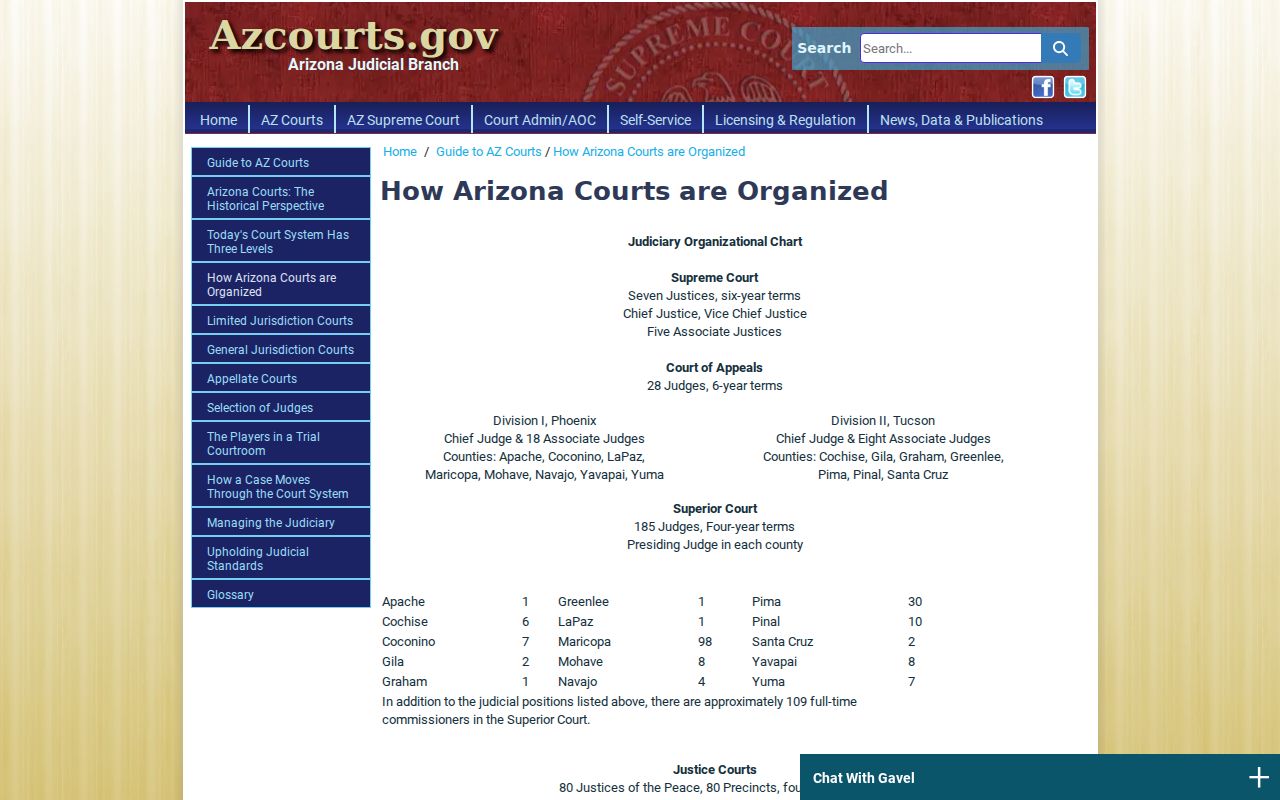
This structure explains why warrant records sit with different trial courts and clerks across Arizona. Trial courts issue them. Appellate courts review cases instead. Arizona has two Court of Appeals divisions and a Supreme Court. Federal cases sit outside the state system entirely. The U.S. District Court for the District of Arizona uses federal dockets, and its clerk is not the county Clerk of the Superior Court. Have the ticket or court notice handy. Use the issuing court printed on it. The court may be unclear. Then the statewide court locator helps identify the right clerk. A county sheriff may execute an Arizona warrant, but cannot replace the court on status, bond, or recall. For statewide court-count context, the Judicial Branch's annual report page publishes the figures.
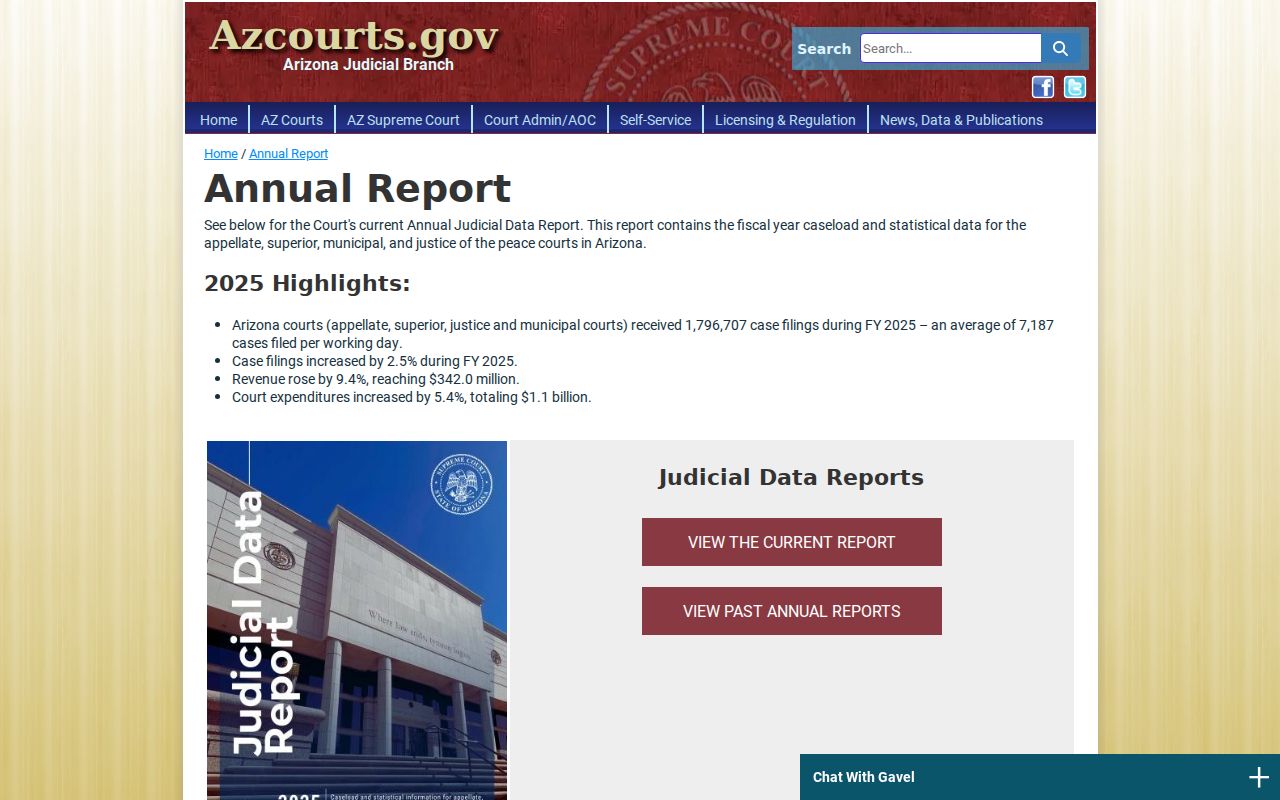
Those court counts measure the judiciary's scale only. They do not count active Arizona warrants. Note: a municipal traffic case may not appear in a Superior Court search or a county sheriff's public list.
Inside an Arizona Warrant Record
Public AZDPS results follow no documented field-by-field schema. The court order behind a listing can say more. Remote access rules may block the document itself. Arizona Rule of Criminal Procedure 3.2 sets the contents of the warrant itself. It identifies or describes the defendant, states the charge, commands the person to appear before a magistrate, and carries a judge's signature. Bail appears when applicable. Arizona's blank statewide felony form adds case, offense, bond, descriptor, and execution-return fields. Those are document fields, though, not a sample of what the public AZDPS search displays. The warrant identifier varies by case. Arizona publishes no standard number pattern for it, so an entry may simply lack that piece.
| Warrant Number | A unique identifier may appear, but AZDPS publishes no standard format; confirm it with the court. |
|---|---|
| Subject | The order identifies or describes a person; a name match alone is not enough to confirm identity. |
| Charge | The court order states the charge or reason; a public search may not display it. |
| Issuing Court | The court whose judicial officer signed the order maintains the official case record. |
| Bond | Terms can change after the initial order; ask the court or jail for the current amount and method. |
| Status | Active, served, recalled, or quashed describes court action; AZDPS does not certify current status. |
A stamp-style identifier means nothing without a verified sample. Arizona publishes no public-format specification for its warrant numbers, so no sample is shown.
Arizona Traffic Holds and Warrants Are Separate
Arizona's Traffic Ticket Enforcement Assistance Program, or TTEAP, ties qualifying delinquent traffic obligations to vehicle-registration renewal restrictions after statutory collection steps. The hold touches registration only. A driver's license is not affected, per the Arizona Judicial Branch. The TTEAP bot asks for a full name and date of birth. It may use a driver's-license number to help match an account. It returns no general warrant-status result. A missed traffic appearance can create a court warrant. Unpaid traffic debt may separately trigger a registration hold. One can exist without the other. Paying online through the statewide court payment channel is reported to clear an eligible hold in about an hour. Direct payment may take until the next business day. A court-approved payment plan may also be an option, and only the court can confirm whether a judge recalled the warrant.
- TTEAP
- Arizona's Traffic Ticket Enforcement Assistance Program for qualifying traffic obligations and vehicle-registration holds.
- Registration hold
- A restriction on renewing vehicle registration, not a court order to arrest someone.
- FTA
- Failure to appear when ordered; the issuing court may respond with a bench or arrest warrant.
- Recall or quash
- A judicial order withdrawing a warrant. Paying a TTEAP balance alone does not issue that order.
Note: TTEAP is a traffic-collection route in Arizona, not a driver's-license history check or a complete warrant search.
Arizona Warrant Service and Court Custody
The issuing court keeps the case file. The serving agency executes the warrant. It then returns the result to the court. County sheriffs commonly serve criminal process and run the county jails, while constables handle Justice Court process in their precincts. Municipal police or marshals may serve city-court matters. Arizona rules also authorize peace officers to execute criminal warrants statewide, so the roles overlap and no sheriff's roster is a full Arizona record system.
The court-to-service path can be summarized as: judicial officer issues the order → issuing clerk keeps the case record → court or local agency routes it to an officer → officer serves or returns the warrant → court records service, recall, or further orders. AZDPS may receive information reported by courts, but its public page does not disclose the reporting roster or technical schedule. Law-enforcement systems such as ACJIS and NCIC remain access-controlled.
Status or bond questions go to the issuing court. Motions go there too. Surrender, custody, or release logistics belong with the county sheriff or jail next. The county directory connects those local routes without treating any one sheriff as Arizona's statewide office.
Arizona Warrant Records and Public Access
The Arizona Public Records Law, A.R.S. §§39-121 and 39-121.01, generally allows inspection of public records held by state and local agencies. It requires prompt access. Confidentiality, privilege, and other lawful limits still apply. Court records follow Arizona Supreme Court Rule 123 instead. Even when an Arizona case docket has a public entry, some documents, including specified warrant materials, may not be available remotely. Juvenile case information is restricted under A.R.S. §8-208. Statutory exceptions and judicial discretion apply. Rule 123 also limits public remote access to specified pre-charge warrant request and issuance information until a release condition occurs. A public-records request can seek a releasable record from the office that holds it. It is not a live validation service, though, and it cannot compel disclosure of sealed material.
Key Arizona Access Rules
A.R.S. §39-121 provides the general right to inspect public records, subject to lawful limits.
A.R.S. §39-121.01 sets public-body duties for prompt access and handling of records requests.
Arizona Supreme Court Rule 123 governs court-record access and remote restrictions on sensitive warrant documents.
A.R.S. §8-208 limits access to juvenile court records, with statutory exceptions.
Pre-Charge Warrant Access Under Arizona Rule 123
Arizona's 2025 criminal-rule changes created a pre-charge arrest-warrant process with its own access limits. A warrant application can move before a charge is filed. That changes what the public sees. While the restriction applies, an online case search will not display the request or its issuance details. Each warrant runs on a defined execution period, and the matter returns to court after an arrest or after the period ends. The Arizona Supreme Court adopted the permanent rule package in August 2026. Its listed provisions take effect January 1, 2027. The emergency procedures govern until then. Check a current rules compilation for any later publication, since forms and access limits shift on their own schedule. Those shifts do not track the AZDPS public search. A visitor comparing the two could miss the difference. Note: a missing public docket entry may reflect a rule-based access restriction, not proof that no court process exists.
Resolving an Arizona Warrant Through Its Court
Arizona court guidance is blunt: a warrant stays in effect until the person is arrested or appears, unless the court quashes it. Only a judicial officer in the issuing jurisdiction can withdraw the order, and no informal agreement with a prosecutor or clerk will substitute for that act. So call first. Ask the Arizona clerk or warrant unit whether the record is active, whether bond is set, and which appearance or motion options the court accepts. For a missed hearing, the usual moves are a motion to quash or recall, a request to reset the date, or a planned appearance. A lawyer can arrange a controlled appearance and explain release conditions. That help is worth it. If the court requires surrender, confirm the right entrance, the timing, the identification, and the bond method before you go. After an arrest, Arizona guidance calls for an initial appearance within 24 hours or release. Records law is a separate lever. A.R.S. §39-121 and related statutes may support a request for a releasable record, though they do not guarantee a live status answer. Arizona has no statewide warrant-amnesty week. It has no uniform recall fee. Arizona's local courts handle payment plans, motions, and warrant-resolution services their own way. Paying a traffic debt can lift a TTEAP registration hold. The warrant itself still needs a court order. Turn to the county directory for the Arizona court and sheriff in the county where the case began.
Arizona Warrant Technology Is Not One System
Arizona does not run one warrant system. Public, court, traffic, and police databases sit apart. The AZDPS public search publishes no launch date, no participation map, and no record count. Public Access reports its own participating-court count and refreshes weekly. TTEAP handles eligible traffic obligations. Maricopa County runs a restricted criminal-justice workflow that tracks electronic warrants across partner agencies. That county tool is not a public statewide portal. More is coming, in pieces. Arizona's Judicial Council minutes from 2025 logged a demonstration of the TTEAP Lookup Bot for viewing traffic fine information and making payments. An arrest-warrant proof of concept involved 10 courts. Planning materials for 2026-28 describe funding and local readiness as prerequisites for broader automation. It is not live statewide coverage. A third track involves search warrants for DUI evidence collection, serving courts and police rather than a public arrest-warrant check. For an actual warrant check, Arizona's public search remains a court-reported lead to verify with the issuing court.
Arizona Warrants by County
Arizona's statewide search is a starting point only. The issuing court confirms whether a warrant is active and sets bond or recall terms. Sheriffs, constables, and city police handle service. Counties differ. The six largest county jurisdictions by the cited 2024 population estimates each run their own local routes, which is why the directory opens a county homepage for each. Use the court named on a citation or result first. Then ask the sheriff about service or custody.
Maricopa County
Phoenix · Arizona's largest county system; the sheriff advertises an online warrant lookup.
Pima County
Tucson · Sheriff guidance points warrant questions to the court of jurisdiction.
Pinal County
Florence · Confirm with the issuing court and sheriff; no public sheriff search was verified.
Yavapai County
Prescott · Sheriff public-record requests provide a route for releasable agency records.
Mohave County
Kingman · The detention line routes calls about warrants, extradition, and holds.
Yuma County
Yuma · The sheriff's warrant unit processes county warrants and does not give status by phone.
Browse the County Directory for all 15 Arizona counties. Each county page maps its court and warrant-records route.