
Arizona Traffic Warrants Explained
In Arizona, a traffic warrant is a court order tied to a case, not a driving-history file. City tickets land in Municipal Court. Precinct matters go to a Justice Court. Each court hears the citations written under its own authority. A judge may issue a warrant after a required appearance is missed in a criminal traffic case. What the Arizona court does next depends on the charge, the notice given, and its own order. An unpaid balance alone does not make every ticket a warrant. Arizona keeps its failure-to-appear consequences and its collection tools separate. A warrant secures an appearance. A qualifying delinquent traffic debt may instead enter the Traffic Ticket Enforcement Assistance Program. One person can face a warrant, a registration hold, both, or neither. The ticket record belongs to the issuing court. Its answer controls the status and the next appearance, even when a statewide service shows related Arizona information.
Arizona Traffic Warrants and TTEAP Are Separate
Arizona's Traffic Ticket Enforcement Assistance Program, or TTEAP, is a collection path in state law for qualifying delinquent traffic obligations. Under A.R.S. §28-1632, the process can lead to a hold on vehicle-registration renewal after required collection steps. Arizona court guidance calls that hold separate from a driver's-license suspension. It touches registration, not the privilege to drive. It also does not order an arrest. A warrant works differently. A judge or magistrate issues it in a case. The issuing court can recall it. Paying TTEAP may clear an associated registration flag, but payment does not automatically quash a warrant or restore a license suspended under a separate action. Take each Arizona problem to the office that controls it.
Key point: In Arizona, a TTEAP registration hold, a court warrant, and a driver's-license suspension are three separate records with different ways to check and clear them.
Arizona FTA and License-Hold Systems
Arizona offers several public channels, and none of them answers the same question. AZDPS runs a court-reported warrant search. The Judicial Branch Public Access tool indexes cases from participating courts. TTEAP tracks obligations tied to a vehicle-registration hold. The issuing Justice or Municipal Court keeps the actual traffic case, and only that court can confirm whether a warrant exists and what action it requires.
| System | What it shows or holds | Run by |
|---|---|---|
| AZDPS Warrant Search | Court-reported warrant information; not real-time, current-certified, or complete. | Arizona Department of Public Safety |
| Public Access Case Search | A weekly case index from participating courts, not a warrant index. | Arizona Judicial Branch |
| TTEAP Lookup Bot | Qualifying delinquent traffic obligations tied to registration renewal holds. | Arizona Judicial Branch and participating courts |
| Issuing court record | The citation, docket, warrant status, balance, and next step for its case. | The Justice or Municipal Court with the case |
Each service has its limits. Arizona publishes no participating-court list for the AZDPS warrant search or for TTEAP. Public Access reports 177 of 184 courts, updates weekly, and may omit some case categories. None of these numbers is a statewide warrant count or proof that every Arizona traffic citation is searchable.
Arizona Traffic Warrant and TTEAP Search Limits
The TTEAP Lookup Bot exists for one job: finding court traffic obligations tied to a vehicle-registration hold. Its public instructions ask for the full name and date of birth of the person and of other possible registered owners of the vehicle. A driver's-license number may help with matching, it says. The lookup can offer a lead on a hold. It does not show an active arrest warrant. Arizona limits the program to qualifying delinquent obligations reported by participating courts or political subdivisions. The Judicial Branch posts no complete live participation list. The public landing page has no court, citation-type, or warrant-status filter. Do not assume every ticket will appear. A missing TTEAP result cannot rule out a separate court warrant, so contact the court named on the citation or case papers. Note: TTEAP is a registration-hold lookup, while the Arizona warrant search and the local court file answer different questions. The Arizona Courts TTEAP page provides the program's public lookup route and its description of the vehicle-registration hold.
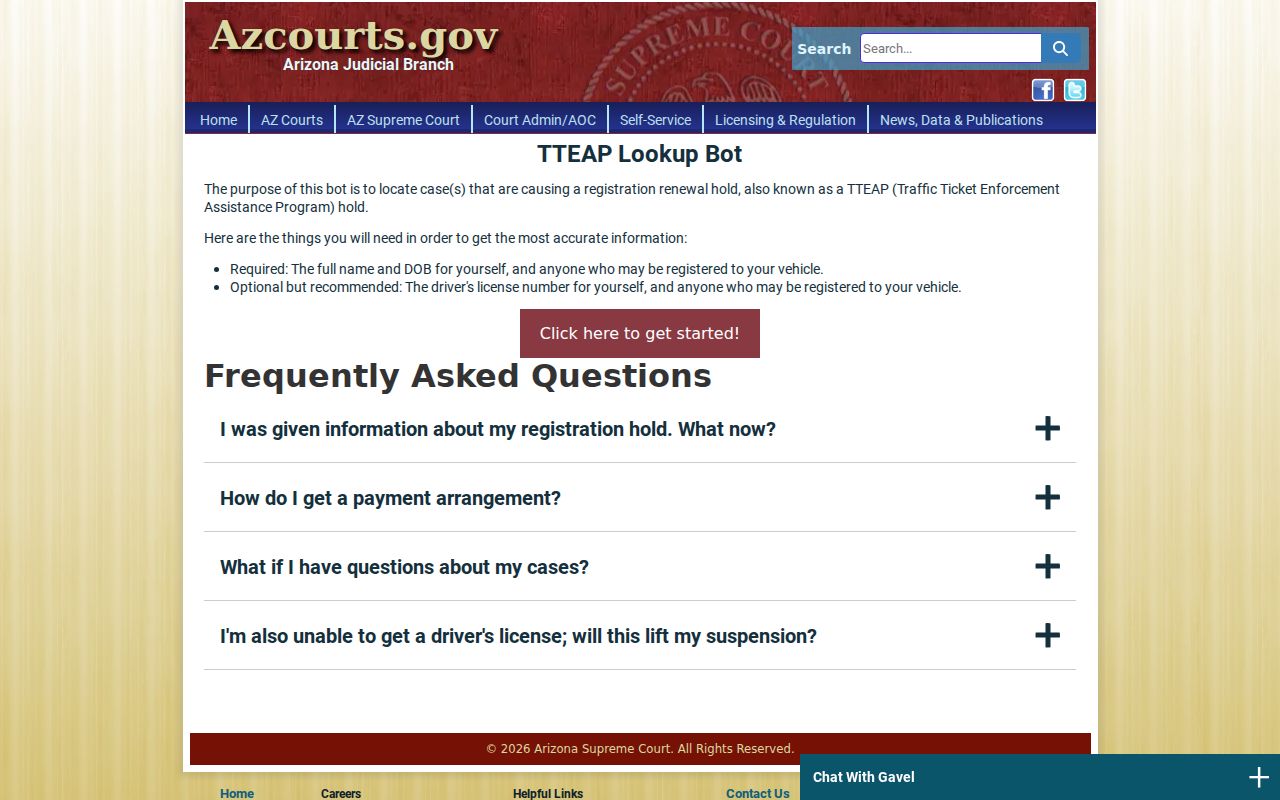
The lookup covers a qualifying Arizona traffic obligation and registration renewal, not a general warrant or driver-license search.
Checking for an Arizona Traffic Warrant
Start with the citation, notice, or court paperwork if you have it. That paper names the court with the case. If it is gone, the Arizona Courts Locator can find the likely Municipal or Justice Court based on the place and type of citation. An AZDPS search may surface a court-reported lead. Results are not real-time or complete. The issuing clerk must confirm any Arizona warrant.
- Search the AZDPS Warrant Search using the required name and date-of-birth fields, and note the listed court if a result appears.
- Use the TTEAP Lookup Bot only to check for a related registration hold, not to confirm a warrant.
- Open the County Directory to reach the local court information for the county tied to the citation.
- Ask the issuing clerk whether the warrant is active, whether bond or a hearing is required, and which payment or motion options apply.
For a traffic matter, the city or precinct court can be the issuing court even when a county sheriff serves the warrant. That split matters in Arizona. A blank search proves nothing. Call the lower court rather than treating silence as proof that no order exists.
Arizona Traffic Warrant After a Missed Date
Miss a date on an Arizona traffic ticket, and step one is learning which kind of case you face. In a criminal traffic matter, the judge can issue a warrant under Arizona Criminal Rule 3.1 after signing an order. Civil money works differently. An unpaid civil balance may head to collections instead. TTEAP eligibility can enter that path too. The citation, the court, and the order together decide which consequence actually applies. Arizona sets no statewide grace period. Ask the clerk each question on its own. Is there a court warrant, and what date, bond, or motion step does the case now require? Has an eligible balance been reported to TTEAP, and which payment resolves the debt and updates the registration hold? Arizona's Public Access Case Search may miss local-ordinance cases. Call the court named on the citation. Note: a TTEAP hold, a missed-date docket entry, and a warrant are separate court actions, not three names for one.
How to Lift an Arizona Traffic Warrant
Pulling an Arizona traffic warrant back off the books is the issuing court's job and nobody else's. The judge may want you to appear, file a motion, pay what the case requires, or take some other step the court sets. The clerk can walk you through the local procedure. But only a judicial officer can recall or quash the warrant itself. One caution: a portal payment, by itself, is no proof the warrant came off. Get confirmation from the court before you assume it is gone.
- Confirm the warrant, citation, and current balance with the issuing Municipal or Justice Court.
- Ask whether the judge requires a hearing, a motion to recall, payment, or a new appearance date.
- If the case has a TTEAP hold, ask the court about the eligible balance and whether a payment plan is available; courts set arrangements at their discretion.
- After resolving the court matter, ask for confirmation that the judge recalled the warrant, then separately verify any registration hold has cleared.
Caution: Paying a TTEAP balance may clear a vehicle-registration hold, but it does not itself quash an Arizona court warrant or restore a separately suspended license.
Arizona Traffic Warrants and TTEAP Timing
Timing matters here, and the Arizona Judicial Branch publishes real numbers. Pay online through the statewide court-payment channel and a TTEAP hold typically clears in about one hour. Pay at the court counter instead and the registration system may not see it until the next business day. Those are hold-update estimates only. They say nothing about how fast a judge might recall a warrant or process a motion. Keep your receipt, and ask the issuing court how to confirm both the account and the hold after the money lands. If more than one court has reported obligations on the vehicle, the Judicial Branch requires every associated TTEAP case to be paid in full unless a court approves some other arrangement. The current Arizona Courts payment and collections FAQ spells out the processing route. Arizona sets no single statewide TTEAP fee amount, so ask the court for the exact total you owe.
Arizona Traffic Warrant Status and Payment Search
A payment lookup is not an Arizona warrant check, and Phoenix Municipal Court shows exactly why. Its payment search takes a payment-contract number, citation number, person number, or case number, yet it displays only obligations the court has approved for online payment. The court itself warns that other amounts or cases may exist. So a payment result cannot tell you whether a warrant is active. That status has to come from the judge or the court. The official Phoenix payment search page lays out the fields used to find eligible amounts and the routes for paying them. It is a fee tool, not an Arizona warrant-status search, and treating it as one is a mistake.
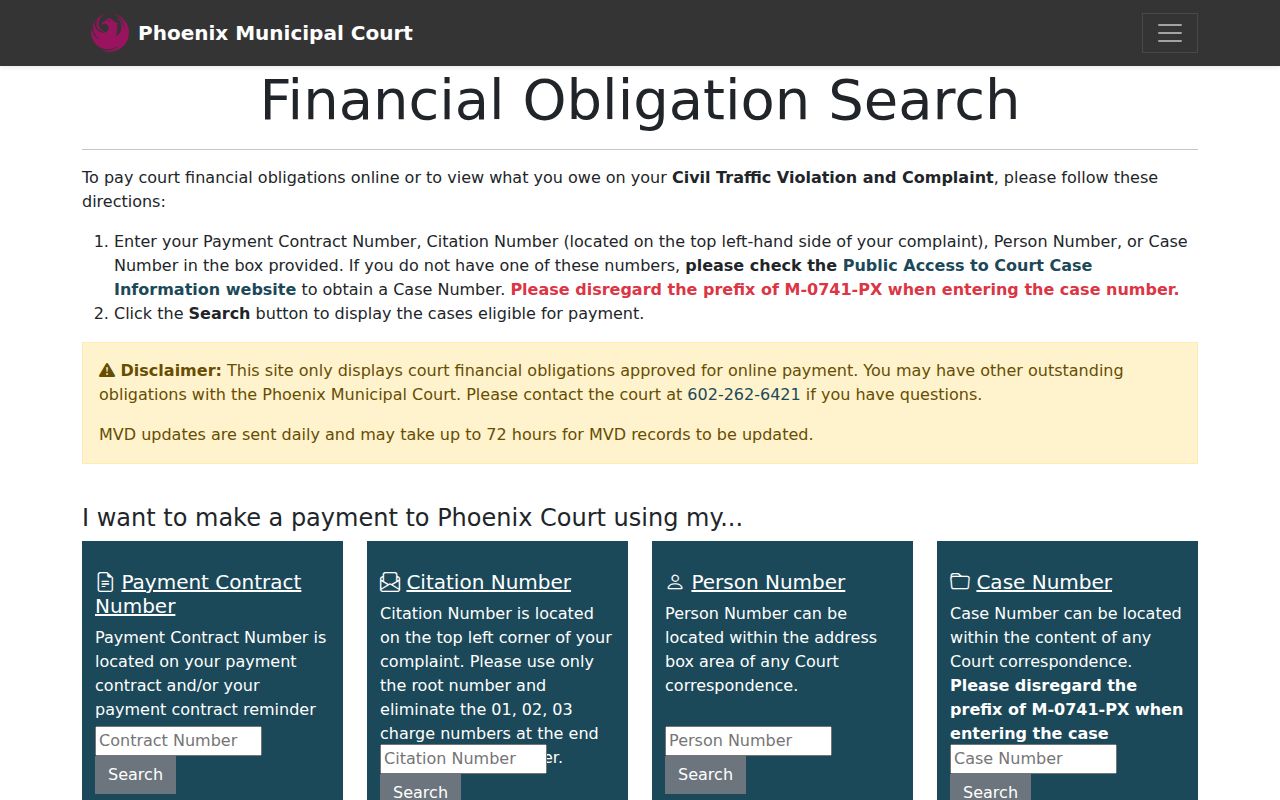
The form's four lookup paths, payment-contract, citation, person, and case number, find eligible amounts. They say nothing about whether an active warrant exists or has been recalled. Phoenix's published payment options list a $20 time-payment fee for eligible extensions or plans and an $18 returned-check fee. Those charges belong to Phoenix alone, not Arizona-wide warrant or TTEAP fees. The court also gives a local MVD update notice of up to 72 hours, which sits apart from the statewide TTEAP guidance on typical payment timing. Check the issuing court's current terms before leaning on any local portal or fee example. Note: Phoenix's portal and fees are local examples and do not set the process for other Arizona Municipal or Justice Courts.
How a Traffic Warrant Differs From a Driver Record
An Arizona traffic warrant is a court order attached to a case. It is not your driving-history file. TTEAP works differently still, as a hold on registration renewal. A suspended license is a third matter, with its own legal basis and its own reinstatement steps. All three can grow out of one traffic case, yet none of them substitutes for checking the other two. Confirm each one on its own.
| Issue | Traffic court warrant | TTEAP hold | Driver's-license suspension |
|---|---|---|---|
| What it is | Judicial order to secure an appearance or authorize arrest under its terms. | Restriction on renewing vehicle registration for an eligible delinquent obligation. | Restriction on the legal privilege to drive. |
| Who controls it | The court that issued the warrant. | The reporting court and the TTEAP process. | The agency or court that imposed the suspension. |
| How to check | Issuing court; AZDPS is an incomplete lead. | TTEAP Lookup Bot and issuing court. | Notice or licensing authority that imposed it. |
| How it clears | Court order recalling or quashing the warrant. | Resolve eligible balance or approved arrangement; confirm hold update. | Follow the separate reinstatement steps for that suspension. |
| What not to infer | No online match does not prove no warrant. | No hold does not prove no warrant. | TTEAP payment does not restore a suspended license. |
For an Arizona traffic case, the court record is where you confirm the citation, the warrant, and the next hearing. A motor-vehicle record or registration status answers a different question entirely. Neither can show that a judge recalled the warrant.