
Arizona Municipal Court Warrants Explained
An Arizona municipal court warrant is an order from a city or town judge covering a case on that court's docket. Municipal Courts in Arizona hear ordinance violations and many traffic and misdemeanor matters within their city limits. Each can issue its own bench or arrest warrants. The issuing court keeps the file. Its clerk runs the docket, so the warrant stays with that office. These Arizona courts sit in a separate lower tier, not under county Superior Court. That matters for any warrant search. A traffic or ordinance case in an Arizona city can carry a different docket, clerk, and serving agency than a felony case would. A statewide or county lookup can point toward a case, but a blank result there does not establish that the municipal court holds no outstanding warrant. For Arizona warrant status and instructions, ask that clerk.
Arizona Municipal Courts Issue Their Own Warrants
The Arizona Judicial Branch counts 82 Municipal Courts staffed by 142 full- and part-time municipal judges. Those numbers describe court structure. They say nothing about how many warrants exist or how often cases produce one. Court counts also shift as the judicial system is reorganized. That scale explains why one county search cannot answer every city-court question. Each Arizona municipal court keeps its own cases and its own clerk. Its jurisdiction follows its city or town authority and no farther. The Arizona courts organization overview lays out the tiers, from municipal and justice courts up through Superior and appellate courts. Read it, then match the court printed on the citation or order.
Note: The 82-court figure describes Arizona's court structure, not a count of municipal warrants or active cases.
Municipal and County Warrants Compared
In Arizona, a warrant belongs to the court that issued it, and the tier matters. A Municipal Court handles local cases. A Justice Court hears precinct matters, including traffic and misdemeanors. Superior Court generally takes felonies and broader jurisdiction. A sheriff may serve the paper, but that role does not make the sheriff the clerk for every city-court case.
| Feature | Municipal Court | Justice Court | Superior Court |
|---|---|---|---|
| Typical matters | City or town ordinances, traffic, and many misdemeanors within the municipality. | Precinct traffic, misdemeanor, civil, and preliminary felony matters. | Felonies and broader case types within general jurisdiction. |
| Warrant issuer | The Municipal Court judge or magistrate in its cases. | The Justice Court judge or magistrate in its cases. | The Superior Court judicial officer in its cases. |
| Record keeper | The issuing Municipal Court clerk. | The issuing Justice Court clerk. | The county Clerk of the Superior Court. |
| Possible serving agency | City police or marshal; other peace officers may act as authorized. | Constable or sheriff; other peace officers may act as authorized. | County sheriff or another authorized peace officer. |
| Public search limit | Local record may not appear in a broader search. | Public case index may be incomplete and is not a warrant index. | Case entry does not guarantee remote access to the warrant document. |
For how the levels differ, see Arrest Warrant Search. It explains why an Arizona arrest warrant can come from one court and be served by another agency. The court tier decides who keeps the record.
Note: Arizona Superior Court generally handles felonies, while Justice and Municipal Courts keep their own assigned dockets.
Arizona Municipal Warrants Stay With Court Clerks
The issuing Municipal Court's clerk holds the case file. Call to confirm the docket, warrant status, and next step. City police or a marshal may serve the paper. A sheriff may also serve it, under state peace-officer authority or local arrangements. They are not always one office. Arizona has no single public search covering every Municipal and Justice Court warrant. The AZDPS Warrant Search pulls reports from various courts, but it publishes no roster of participating courts and promises no complete coverage. An Arizona lower-court case can be missing from a county sheriff page or a statewide result. Ask the city court's clerk, using the name on the citation. Or use the Arizona Courts Locator to find the right court.
Checking an Arizona Municipal Warrant
Begin with the citation, summons, or case notice. It names the city or town court handling the matter. Arizona Public Access may help you find a case, and AZDPS may return a court-reported warrant lead. Neither is a complete municipal warrant register. The check is not done until the issuing Arizona court's clerk confirms the current status and tells you what appearance, bond, or motion applies.
- Identify the city court named on the ticket or order and gather the case or citation number.
- Use official court search tools as leads, keeping in mind that a case index is not a warrant-status check.
- Open the County Directory to reach local court information for the county where the city case arose.
- Contact the municipal clerk to verify whether the warrant is active, what bond or appearance applies, and how to request recall.
No citation in hand? Use the Arizona Courts Locator to find the likely court from the location and the kind of case. A county jail or sheriff search alone is not enough. Those sources may only show custody or the warrants reported to that one agency.
Arizona Municipal Warrants May Miss Public Access
The Arizona Judicial Branch Public Access service is a case index, not a warrant index. It reaches a lot of courts. Case information flows in from 177 of 184 courts, and the data refreshes weekly. Participation is not completeness. The service itself warns that a participating court may not send every case. Local-ordinal charges are one category that can be absent. A city ordinance case can therefore drop out even when the Municipal Court holds an active docket entry. Viewing the order is a separate hurdle. Arizona Supreme Court Rule 123 restricts remote access to some sensitive records, and a listed case event is not the signed warrant order. Ask the issuing court directly. The 177-court count describes only the case index, and it says nothing about which municipal warrants appear online. A blank Arizona Public Access result does not prove that a city-court warrant is absent.
Inside an Arizona Municipal Warrant
Arizona posts no common online format for municipal warrants. The signed order and the court's public case display are two different records. City sites can show different fields for one case. Match the court and case number first. Then ask the clerk to explain any status term or release condition that reads unclear.
| Warrant number | A local identifier may be used, but Arizona publishes no shared municipal warrant-number format or universal public display. |
|---|---|
| Person named | The legal order identifies or describes the person; public search results may provide less detail. |
| Charge or ordinance | The court record ties the order to the case, citation, or ordinance at issue. |
| Issuing court | The Municipal Court and case number identify the clerk who can confirm the official record. |
| Bond or fine | A warrant may state bail when applicable. Any balance or release term should be confirmed with the court. |
| Status and service | A docket may record whether an order was served, recalled, or remains open; terminology varies by court. |
Arizona Criminal Rule 3.2 spells out what a criminal warrant must contain. Online searches are another story. Arizona sets no requirement that every item appear in a municipal court's results. Arizona DPS does not document every field either. So read any field table with care. It is a reading aid, not a promise that each Arizona city portal shows all six items. Ask a clerk to confirm, since municipal portals may not display the warrant document or a current status code.
Local Arizona Municipal Motion Examples
Municipal courts in Arizona handle recall requests differently. Phoenix Municipal Court gives one clear local example. Its FAQ allows a motion by email or by mail. The motion explains the missed date or payment, states the relief requested, and includes supporting documents. Then the judge decides. A judge may recall the warrant, set payment terms or a new hearing, or leave the warrant active. Phoenix reports a response time of about 10 days for these motions. That number is a Phoenix estimate. It is not a statewide deadline for Arizona courts. Filing methods and forms differ from city to city. Another Arizona city court may require a different form, an appearance, or different timing. Ask the clerk of the issuing court what it accepts. The official Phoenix Municipal Court FAQ lays out that Arizona court's own motion route.
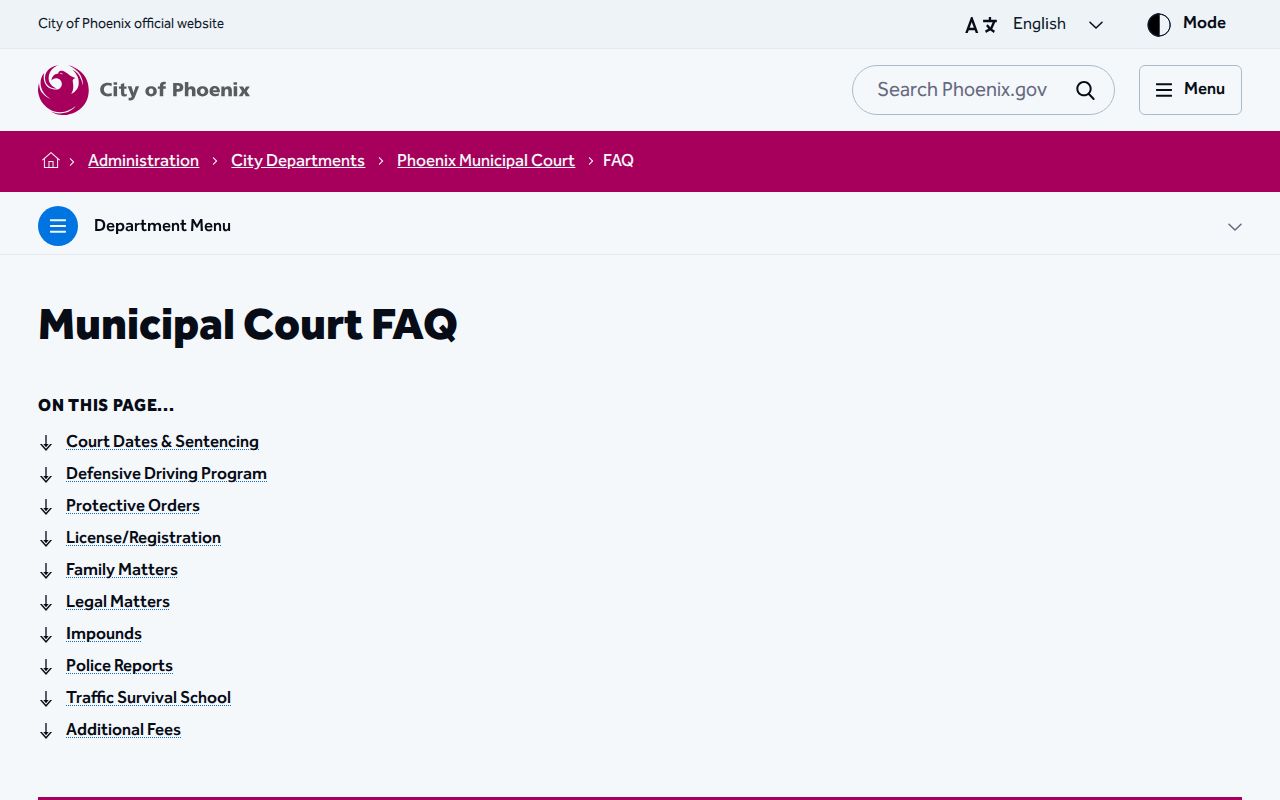
That Phoenix page is only the FAQ landing page. Confirm current motion instructions with that court, and follow the issuing court's own process elsewhere in Arizona.
Arizona Municipal Warrant Terms Explained
Arizona courts have a plain vocabulary for missed appearances. They usually say bench warrant or arrest warrant. The phrase "capias pro fine" is not the ordinary public term for a traffic or fine-collection warrant in Arizona. Other states' materials use it. So follow the wording on the court's own record whenever an Arizona notice uses a term you do not recognize.
- Failure to appear (FTA)
- Not appearing at a court date when ordered; the court may issue a warrant or another order.
- Bench warrant
- A court order often used to secure an appearance or compliance after a missed date or order.
- Quash or recall
- A judicial order withdrawing a warrant. Only the issuing court can do this.
- Capias pro fine
- A term used in some states for a post-judgment fine warrant; it is not Arizona's ordinary traffic-warrant label.
Note: Arizona court guidance generally uses bench warrant or arrest warrant when a city-court appearance is missed.
How to Resolve an Arizona Municipal Warrant
Go straight to the court that issued the Arizona municipal warrant. Ask whether the order is still active. Ask what hearing or bond applies. Ask too whether the judge will hear a motion to recall or reset the matter. Paying the balance or arranging a payment plan can resolve part of the underlying case. It is not an order recalling the warrant. Each Arizona city court sets its own procedure, and each case differs.
- Confirm the municipal court, case number, warrant status, bond, and next required date with the clerk.
- Ask whether to file a motion, appear before the judge, request a reset, or arrange a planned surrender.
- Resolve the underlying charge or fine using a payment or plan the court approves.
- Request confirmation that the judge recalled the warrant and ask whether any separate registration hold remains.
Caution: An Arizona municipal warrant does not clear just because a payment appears online; confirm the judge's recall order with the issuing court.