
Arizona Bench Warrants Explained
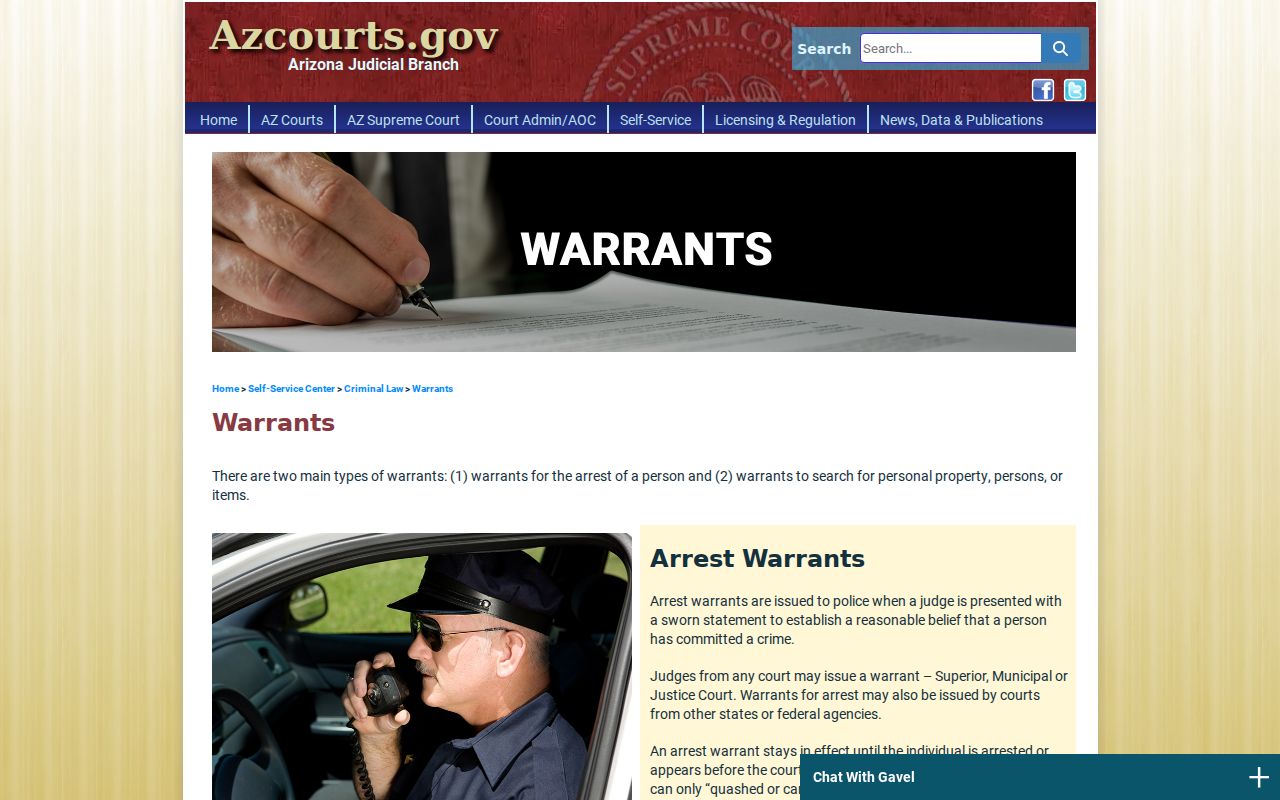
A judge in Arizona signs a bench warrant to bring someone back before the bench, most often after a failure to appear. A failure to appear, or FTA, simply means a required court date came and went without the person. Arraignment, pretrial conferences, trials, and traffic hearings are the usual settings. Release-condition violations and other broken court orders can trigger the same order. What happens next depends on the judge and the case, so treat one missed date as a question for that court rather than a fixed statewide rule. The Arizona Judicial Branch warrant guide lays out both bench and arrest warrants and points toward resolving them through the courts.
Arizona's trial courts do not share every docket. Felonies generally sit in Superior Court. Precinct traffic and misdemeanor cases may belong to Justice Court, while Municipal Court handles city ordinance matters and many local traffic cases. Whichever court set the date keeps the file and decides whether a bench warrant is active. A statewide public search can locate a case, but it may miss a lower-court order entirely, so check with the issuing court directly.
Arizona Bench Warrants Follow Missed Hearings
Missed a hearing in Arizona? Start with whatever papers you have: the notice, the ticket, or the case documents that name the court. A traffic date set in a city court goes back to that Municipal Court, while a precinct citation likely belongs to Justice Court. Superior Court handles felonies and many family matters. The filing court matters because a broad county or statewide search may not surface every lower-court warrant. If the paperwork is gone, a court locator can point you to the right clerk. When you call, ask whether a warrant issued, whether it is still active, whether a bond or hearing is set, and how the judge accepts a request to reset or recall. Do not assume a missed payment or the absence of a reminder letter settles the question; the court's order does. For local court and sheriff routes across Arizona, use the County Directory.
Note: The missed court's clerk can identify its docket, while the judge decides whether a warrant is recalled or a new date is set.
How Arizona Bench Warrants Are Issued
In Arizona, a judge or another authorized judicial officer issues a bench warrant under the rules governing that case. The order exists to secure an appearance or enforce an obligation. It is not a new charge. Common triggers include an FTA at a required hearing, noncompliance with a court order, or another failure the case recognizes. Arizona publishes no statewide notice or grace period covering every court and case type. Once issued, the warrant stays with the court file. It may reach law-enforcement systems or an agency expected to serve it. AZDPS does not say which courts report each warrant or how its public index gets refreshed, so do not assume every Arizona bench warrant lands in a public portal, a sheriff site, or a federal database. A judge can recall or quash the order, and the official court record should show that action.
In plain terms, the path is: missed obligation or other court trigger → judicial order → local court record and possible law-enforcement reporting → service, appearance, or judicial recall.
Arizona Uses FTA, Not Capias Pro Fine
Arizona guidance for courts leans on the terms "bench warrant," "arrest warrant," and "failure to appear." Capias pro fine is not the label Arizona normally uses for a traffic failure-to-appear tool. A traffic case can also trigger a separate registration hold through TTEAP, so a fine, a warrant, and a vehicle hold are three different records.
- FTA
- Failure to appear at a court setting when ordered.
- Bench warrant
- A court order to secure an appearance, often after an FTA or order violation.
- Recall or quash
- A judge's order withdrawing or canceling a warrant.
- Capias pro fine
- A term used in some states for a post-judgment fine warrant; it is not Arizona's ordinary public-facing traffic term.
- TTEAP hold
- A vehicle-registration renewal restriction tied to qualifying traffic obligations, separate from a court warrant.
Using the right term routes your question to the right record holder. Ask the issuing court about a bench warrant. Contact the court or program about a TTEAP hold.
Bench and Arrest Warrants Compared
Both orders can authorize an arrest, but they start differently. A bench warrant answers a court obligation, like a missed hearing. An arrest warrant follows a sworn showing of probable cause that an offense occurred and that the named person did it. Arizona law lets a magistrate issue an arrest warrant under A.R.S. §13-3897. For a closer look at that separate process, see the Arrest Warrant Search.
| Feature | Bench Warrant | Arrest Warrant |
|---|---|---|
| Common trigger | Missed hearing, FTA, or failure to comply with a court order. | Judicial finding of probable cause under the applicable process. |
| Case setting | Often tied to an existing court case or required appearance. | May issue before or during a criminal case, depending on procedure. |
| Record holder | The court that issued the bench warrant. | The court that issued the arrest warrant. |
| Resolution | Ask the issuing judge about recall, quash, or a new appearance date. | Confirm service, bond, and appearance instructions with the issuing court. |
Neither label tells you the current bond or release terms. The docket and any later judicial order control, so a public search result alone may not say what happens after contact with law enforcement.
Note: The same court tier can handle more than one warrant type, but the legal trigger and case status remain different.
Arizona Municipal Warrants Stay With City Courts
City cases stay in city hands in Arizona. Municipal Courts hear ordinance violations, traffic matters, and many misdemeanor charges filed within city limits. Each court's own clerk keeps its files. City police or marshals serve the paperwork. A warrant from a Municipal Court does not slide into the Superior Court's file just because both courts share the same county. Justice Courts work the same way with their own dockets and clerks for the cases before them. This split explains a common phone call in Arizona. When a county sheriff tells you to contact the court, that is a pointer, not a brush-off. The court holds the authority over the warrant's status. So if a citation or notice names a Municipal or Justice Court, ask that clerk directly about the bench warrant, a motion to set it aside or recall it, and whether the judge will consider a new date request. The county directory can help you find the local court and sheriff. It cannot substitute for the court's own decision.
Resolving an Arizona Bench Warrant
Only the issuing court can cancel an Arizona bench warrant. A person can ask for a new court date or file a motion to quash or recall the warrant. The local court's procedure and the judge's order control everything from there. A clerk can tell you where to file and which form to use. But no clerk has power to cancel the order. That step belongs to a judicial officer alone. If the charge is serious, or you are unsure of the safest way to appear, talk to a lawyer before you act.
- Identify the case and the court from the ticket, notice, or docket.
- Ask the clerk whether the warrant is still active, whether bond is set, and what hearing or filing route applies.
- Ask whether the court accepts a motion to recall or quash, or a request to reset the missed appearance. Follow its filing rules and include supporting papers where required.
- If directed to appear or surrender, confirm the correct location, time, identification, bond method, and whether a judge will be available.
- After any payment or court appearance, confirm that a judge's recall order was entered. Resolve a separate TTEAP hold through its own court or payment channel.
Pima County runs a bench-warrant resolution service that shows one Arizona county's contact route.
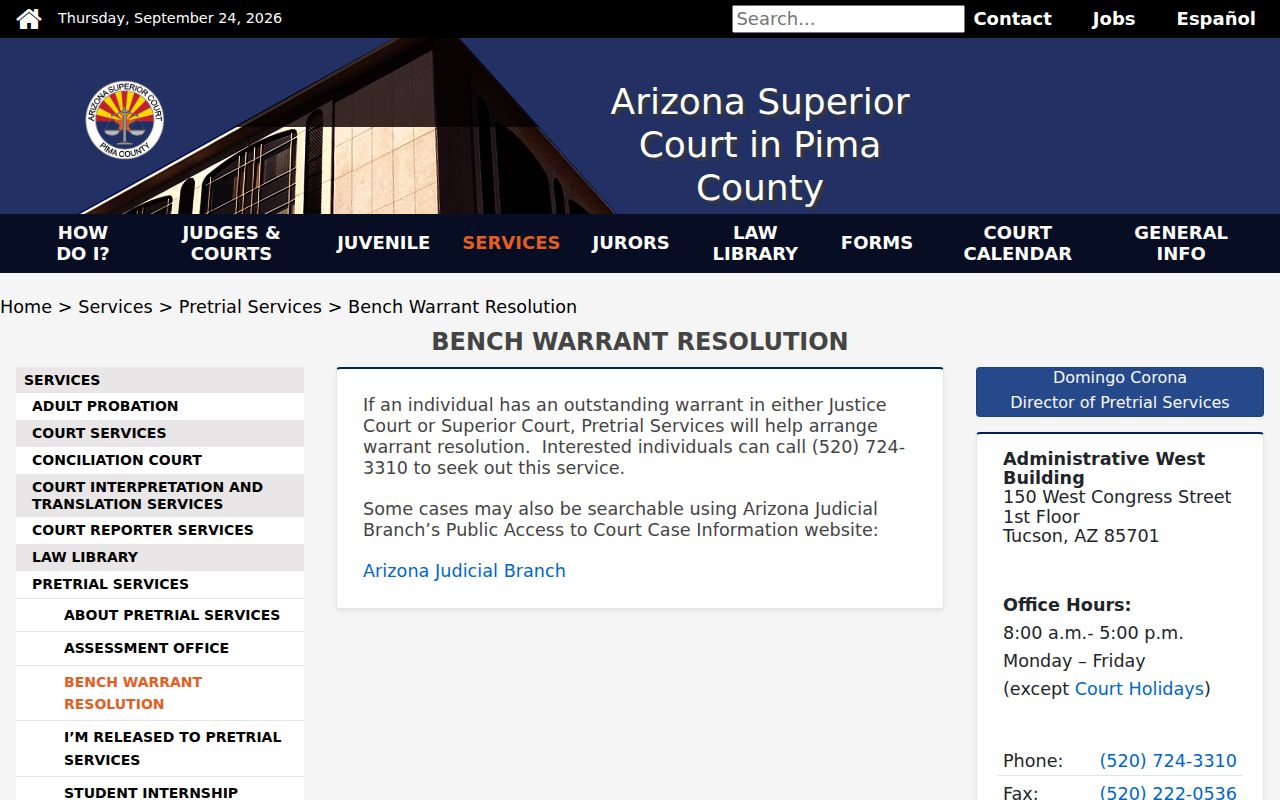
That program is county-specific. Use the County Directory to find the Arizona court and local process tied to your case.
Caution: Do not assume an online payment or a new court date has cleared the warrant; confirm that the issuing judge entered a recall or quash order.
Note: A motion is decided by a judge; the clerk can provide filing steps but cannot withdraw the warrant.
Arizona Bench Warrant Recall Needs a Judge
A recall or a quash is a judge's act. It withdraws the warrant by order. Phone calls, fine payments, and bond arrangements do not cancel a bench warrant by themselves. The judge might set a new appearance date, adjust release terms, or require you to show up before ruling on the request. Ask what will happen in your specific Arizona case and how the court records its decision. Keep a paper trail of anything you file or pay. If a traffic case also carries a TTEAP registration hold, the two tracks must be checked separately. A qualifying payment through the court's collection process may clear a registration hold. The bench warrant still waits for the court's order. The reverse holds too. A judge's recall does not guarantee that a vehicle registration flag has cleared. Keep the receipt or the order, and verify each record with the office that controls it. Arrest situations run on a different clock. Arizona court guidance says a person arrested on a criminal warrant should get an initial appearance within 24 hours. At that hearing a judge takes up release conditions and the next court date, which is not the same thing as a pre-arrest motion to recall, and the options depend entirely on the case.
Finding the Court That Issued It
Arizona sorts warrant work by case type. The Superior Court tier keeps its files with the county Clerk of the Superior Court. Justice Courts and Municipal Courts hold their own lower-court records. Federal warrants sit with the U.S. District Court under federal process, apart from Arizona's state court structure. Treat the table as a starting point. It does not promise that every record is online.
| Court tier | Warrant-related cases | Record route |
|---|---|---|
| Superior Court | Felonies, some probation or restitution matters, family and child-support proceedings. | County Clerk of the Superior Court. |
| Justice Court | Precinct traffic, misdemeanor, civil, and preliminary felony matters. | The Justice Court clerk for the case. |
| Municipal Court | City or town ordinance cases and many local traffic or misdemeanor matters. | The issuing city or town court clerk. |
| U.S. District Court | Federal criminal cases and federal warrant process. | U.S. District Court Clerk or the relevant federal agency. |
Do not know which court handled the case? Start with the Arizona Courts Locator. To check statewide channels first, try the Warrant Lookup. For clerk and sheriff contacts near you, open the County Directory. A county sheriff can explain service or custody logistics. Only the issuing court confirms an Arizona warrant's status and controls its recall.
Note: The federal district court is a separate jurisdiction; county court resources help with Arizona state matters, not federal case status.
Arizona Bench Warrant Documents May Be Restricted
A public case entry does not mean you can view the warrant itself from home. Arizona Supreme Court Rule 123 bars remote public access to certain sensitive court records, including some warrant documents. It also limits access to certain pre-charge arrest-warrant request and issuance information until the rule's release conditions occur. So the visible docket and the underlying judicial document can differ. Arizona Public Access adds its own limits. It is only a case index, sits behind a CAPTCHA gate, and may omit cases even from participating courts. Juvenile records face separate restrictions under A.R.S. §8-208. A blank or thin online result proves little. Ask the issuing court whether the file is restricted and what route exists. Public-record laws do not unseal sealed material or replace direct confirmation of an active warrant.
Note: The court can explain whether a restricted document is unavailable online and what access process applies in that case.