
Arizona Arrest Warrants Explained
An Arizona arrest warrant is a judge's written command. It directs peace officers to take a named person into custody and bring that person before a judicial officer. A search warrant is different. It authorizes a search, not an arrest. In Arizona, a Superior Court felony case can produce one, and so can a matter before a Justice or Municipal Court. The court with the case controls status. For a felony, A.R.S. §13-3897 lets a magistrate issue an arrest warrant when a sworn or affirmed affidavit establishes probable cause that the offense occurred and the named person committed it. The affidavit has to show facts. Arizona Rules of Criminal Procedure 3.1 and 3.2 cover when a summons or warrant may issue and what the order contains. A summons asks the person to appear. A complaint, an indictment, or an affidavit may be part of the path. The route depends on the case and the judicial officer's finding. Arizona's criminal rules set the procedures for issuing one.
How Arizona Arrest Warrants Begin
Probable cause is the threshold. It means the facts give a reasonable basis to believe an offense occurred and that the person named committed it. A sworn affidavit puts those facts in front of the magistrate. The magistrate reviews it. A warrant never issues on an agency's request alone. Arizona's felony-warrant statute spells out the magistrate's authority and the affidavit standard. The rules also cover the summons. A summons asks a person to appear without authorizing an arrest first. The charging path varies. Felonies generally sit in Arizona Superior Court, while Justice and Municipal Courts hear their own lower-court cases and can issue warrants in matters before them. An Arizona arrest warrant points back to one case. It ties to a particular judicial officer, so a citation, notice, or case number helps the issuing clerk find the record; a statewide search result alone never replaces the court's order.
- Probable cause
- Facts that meet the legal basis for the requested warrant or other court action.
- Affidavit
- A written statement sworn or affirmed to support the request.
- Magistrate
- A judicial officer with authority to perform specified acts, including issuing warrants.
Inside an Arizona Arrest Warrant
Arizona Criminal Rule 3.2 describes the legal order itself. It covers the order, not a website display. The judge must sign it. It must identify or describe the defendant, state the charge, command an appearance before a magistrate, and state bail when the offense is bailable. The official document may carry more case and service detail than any index shows. Arizona sets no standard public result fields, so the clerk is the one to ask what is available and whether the warrant is still in effect.
| Warrant number | AZDPS says a warrant number identifies one warrant, but it publishes no statewide number format or complete result-field list. |
|---|---|
| Person and charge | The legal order identifies or describes the defendant and states the charge. A public result may omit details. |
| Issuing judicial officer | The warrant is signed by a judge. The issuing court and case number help the clerk locate the record. |
| Command | The order directs the person to appear before a magistrate; it may include directions for execution. |
| Bail or release terms | The warrant states bail when the offense is bailable. Confirm any current amount or conditions with the court. |
| Service and return | A filed form may record execution and return details. These are not guaranteed to appear in a public search. |
Read result fields with care. A missing bond field does not mean no bond exists. A listed amount can also change, so do not treat it as current. Arizona does not publish standard result fields for every court, and the clerk can confirm what a warrant record really shows.
Arizona Pre-Charge Arrest Warrant Access
Arizona rules include a separate pre-charge path. It covers warrants sought before any charge is filed. The request and issuance material can carry special confidentiality limits until service or another release event. A name search may show nothing. A case index may stay silent too. Warrant material can be moving with nothing visible online. Arizona Supreme Court Rule 123 sets remote-access limits for sensitive court records, including pre-charge warrant material. A public-records request does not override that. Asking under the Arizona Public Records Law will not lift a court access restriction. Ask the issuing clerk instead what docket information is open and when a restricted document may be released.
Arizona Warrant Search Results Are Leads
Treat any Arizona warrant search result as a lead. The Arizona Department of Public Safety Warrant Search takes a first name, last name, and date of birth, and caps a search at five results. AZDPS says the data is not real time. The agency does not represent it as current, active, or complete. Similar names and birth dates can return false matches. A repeated warrant number also does not mean the person has several warrants. Use a hit to find the court to call. That result is not a certified document. The Arizona Judicial Branch Public Access Case Search is a case index rather than a warrant index. It updates weekly, stays incomplete, and withholds some categories. An Arizona case entry can list a docket event without letting you view the warrant itself. No match does not mean no warrant. A warrant can still sit in a court record that no online service shows. Note: AZDPS does not publish its participating-court list, reporting date range, or a completeness guarantee for the public warrant search.
Serving Arrest Warrants in Arizona
Under Criminal Rule 3.3, any Arizona peace officer may execute a criminal warrant. Who appears depends on the case. Local assignment drives the choice in most instances. A county sheriff executes county criminal process under A.R.S. §11-441, sometimes through a jail or warrant unit. A constable serves Justice Court precinct process under A.R.S. §22-131. Municipal police or a city marshal may serve city-court warrants. Arizona DPS also has a statewide law-enforcement role. The issuing Arizona court stays the record keeper no matter who serves the order. Arizona sets no single service schedule here. Nor does any agency promise which unit will act. Ask the issuing court which unit holds the warrant and what appearance or surrender route it accepts. If an arrest happens, a judicial officer handles release and bond. The case then continues under its own process.
Arizona Arrest Warrant: 24-Hour Rule
Arizona court guidance requires a person arrested on a criminal warrant to go before a judicial officer within 24 hours or be released. That first appearance settles several things. The judicial officer addresses the charge, counsel rights, probable cause for release, and conditions such as bond. Exact terms depend on the court. No statewide bond amount follows from a search result. The person may ask to see the warrant. Under Arizona Criminal Rule 4.1, the officer must show it as soon as practicable on request. The official Arizona criminal-case steps page explains the initial-appearance process. A family member can help. Locating a lawyer or a court contact is a fair ask. The issuing court remains the place to confirm the Arizona record, release terms, and next date.
Note: Posting bond addresses release and required appearances; it does not dismiss the Arizona charge or erase the case record.
Comparing Arrest, Summons, and Bench Warrants
An Arizona arrest warrant, a summons, and a bench warrant all draw on court authority, yet each does different work. A summons tells a person to appear. It does not command an arrest first. An arrest warrant authorizes custody on the order's terms. A bench warrant often follows a missed appearance. It can also follow failure to comply with an order. For missed-hearing cases, the Bench Warrant Search page covers Arizona's separate court process.
| Record type | Arrest warrant | Summons | Bench warrant |
|---|---|---|---|
| Purpose | Authorizes arrest and appearance before a judicial officer. | Orders a person to appear without first authorizing arrest. | Secures appearance or compliance after a court order or missed date. |
| Common starting point | Probable-cause finding under the rules for the case. | A case in which the rule supports appearance by summons. | Failure to appear or comply, as determined by the court. |
| Who issues it | Judge or magistrate. | Court process under the applicable rule. | The court handling the matter. |
| Next step | Confirm status and release terms with the issuing court. | Attend by the date and follow the notice. | Ask the issuing court about recall, a new date, or appearance. |
The labels are not interchangeable. Follow a summons date as written. Do not assume an arrest order already exists. A bench warrant may still arise if an Arizona court finds an appearance or order was missed. The docket and the judge's order settle what applies in the case.
Which Arizona Court Holds an Arrest Warrant?
Which court issued the warrant depends on the case. Arizona Superior Courts generally handle felonies. Justice Courts take precinct-based traffic, misdemeanor, civil, and preliminary felony matters. Municipal Courts hear city or town ordinance cases and many traffic and misdemeanor matters within their jurisdiction. Each lower court keeps its own record through its clerk. Its clerk is the contact. No single county clerk holds every Arizona warrant. If the notice or an AZDPS result does not name the court, use the Arizona Courts Locator to find the likely one. Then ask that court's clerk or warrant unit to verify the case. The County Directory routes to local county information for courts and sheriff channels. A sheriff or constable may help with service. Neither replaces the Arizona issuing court's status confirmation.
Note: A county sheriff's inmate list, an Arizona DPS search, and a court docket answer different questions and may not show the same record.
If There Is an Arrest Warrant for You
Confirm first. If an Arizona search or court notice suggests an arrest warrant, verify it before making plans. Contact the issuing court or a criminal-defense attorney. Ask whether the warrant remains active, what bond or release conditions apply, and which agency handles an appearance. Ask about a motion too. The court may accept a scheduled surrender. The County Directory is the route to local county information, reaching the right court and sheriff channel for the Arizona case.
- Write down the court, case number, and warrant number shown in the official result, if provided.
- Call the issuing court or warrant unit to confirm current status and ask what procedure it requires.
- Discuss a motion, a planned appearance, or surrender with counsel; only the issuing court can quash or recall its warrant.
- If directed to appear, confirm the location, timing, bond method, and whether a judicial officer will be available.
One county Superior Court's warrant information page offers contact and self-surrender instructions. It shows one Arizona court's local approach.
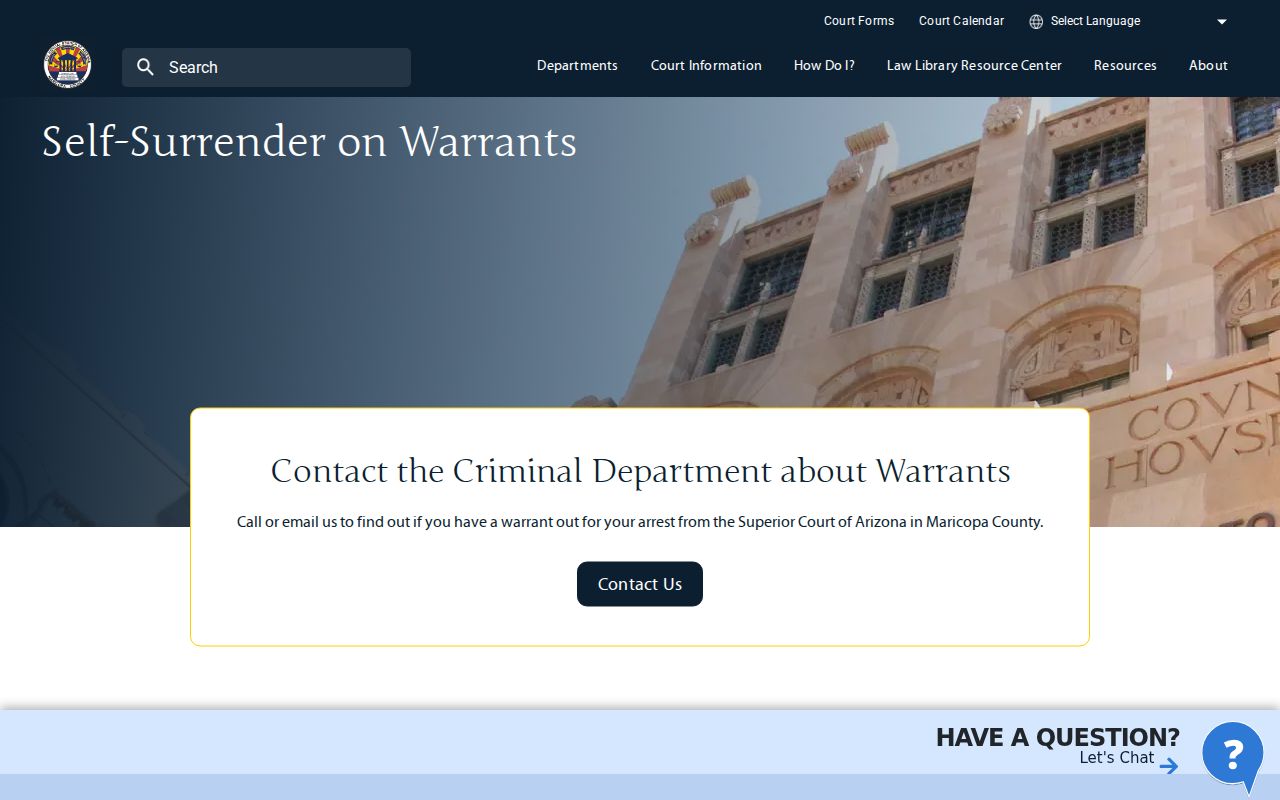
That page belongs to one county. Use the court and sheriff channels for the Arizona county that issued your warrant.
Important: An active Arizona arrest warrant can lead to custody when officers execute it; confirm status, appearance, and release steps with the court before acting.